I use Iprofile which is the online CV designed to make life easier for recruiters.
However, the system is extremely buggy, insecure and worse that that it's next to impossible to contact iprofile as they seem to ignore support requests sent through their webform and like so many user-hostile websites fail to publish a support phone number. Non existent customer service? Time for them to "read my blog"!
If you are experiencing similar difficulties with iProfile and want their customer service phone number it is available on the parent group website and just in case you missed it, here it is: 020 7025 0555 (I will also post the variant 02070250555) just to ensure it is picked up by search engines.
I was thinking of launching a startup website where people could log faults and see what faults had been logged, a bit like bugzilla but just as you can search for bugs in bugzilla by project, my idea would be that you could search and log bugs on other people's websites irrespective of whether they used bugzilla or not. Users could then vote on the bugs they wanted fixed first and if the company had any sense, they would look at the lists and do something about it. Here is this morning's batch of iprofile issues:
iprofile.org, bug 1. When I apply for a job, the acknowledgement I get back has someone else's email address in the candidate username link. This is a security risk as it exposes someone else's details (they work at barclaycard). I told you about this bug in May, you eventually responded in May saying the only way to fix it was the rather poor cop out of rebuilding my profile. I reluctantly agreed, however the bug is still present. Why?
iprofile.org, bug 2. My available from date has to be today or a date in the future. I have set it to today's date and I do this whenever I go into iprofile. However, several hours later I find it reset to a date 6 weeks ago in June which means I have to go in and manually change it again. Please fix this bug as it presents misleading information to prospective employers. I see you have also fixed the related bug which changes my jobseeker status from "actively looking" to "not actively looking", however other related problems persist.
I am aware of similar sites such as suggestion box but what I'm after here is more along the lines of a cross between that and utest.
Irrespective of your issues with iprofile, you might like to vote for this idea on reddit, maybe it will get some investors my way and we can start to use crowdsourcing to shame buggy websites into fixing their problems - satisfied users might actually help such sites to make more money?
Craig


28 July 2008
Homecoming Scotland
Please visit homecomingscotland2009.com for details of a major programme of events throughout 2009 to celebrate Scottish culture and to mark the 250th anniversary of the birth of Robert Burns.
23 July 2008
Sorting out UK Government data privacy
Please view this idea I posted on the Better Regulation website to attempt to sort out the conflicts in UK privacy laws. Comments welcome. Following my posting here, this letter was published in this week's computing magazine.
Craig
Craig
18 July 2008
The demise of the Scottish entrepreneur
Two days ago I posted that Scotland's answer to Dragons Den had ceased trading.
I came across this note I posted to the First Tuesday Scotland network on 9th June 2003, over 5 years ago.
It seems not much has changed in that time to support the Scottish Entrepreneur, indeed with this week's announcement things are only getting worse. Sorry to sound so pessimistic but I tell it as it is.
In message <BPEDJNPNLJEFMFCOBAMOIEDDDOAA.gordon@firsttuesday
scotland.com>, Gordon MacIntyre-Kemp <gordon@firsttuesdayscotland.com>wrote:
>
>For about 6 years I have disagreed with the direction of Scottish Enterprise
>as a whole and that is why I left the organisation to set up this network.
>Economies are driven by confidence and positivity, demand and the
>availability of disposable income. Regardless of the expertise of the man at
>the top and the people throughout the organisation SE can only do the
>bidding of the Scottish Parliament and this is where it goes wrong - it suffers
>from public sector thinking - good people hamstrung by red tape and politics.
>
I replied:
The public sector mentality is about as far removed as you can get from the
rapidly moving and flexible environment of being an entrepreneur.
Scottish Enterprise may be headed by a competent individual, but this is little
better than having a competent train driver. If the network operator can't work
the points, you end up permanently on a slow line or a dead end siding.
There needs to be a total change of mindset in the executive and at UK level
before anything serious begins to change.
How about assessing businesses on the quality of the idea, the opportunity it
addresses and the likelihood of success rather than engaging in little more
than a box ticking exercise, or claiming to provide a service for info which can
be easily obtained on line, or assessing businesses based on the number of
birthdays the founder has had?
Scotland is famous for its inventors - people who have changed the world and
been huge successes. What support is there for these people from Scottish
Enterprise? What help in filing for a patent would there be for today's John
Logie Bairds or Alexander Graham Bells or more widely James Dyson or
Trevor Bayliss both of whom had huge obstacles in getting products to
market.
What help would there be in helping the lone entrepreneur with a brilliant idea
if they have little or no resources of their own to do it? Such people would of
course be precluded from the "Proof of concept" funding because this is tied
to working in a research establishment.
Furthermore there is a huge contradiction when it comes down to help for the
entrepreneur. Businesses are supposed to be flexible, geared up for parents
with flexible working needs, geared up for people wanting to work part time,
geared up for distance working etc with all these directives and laws being
passed. So you tick all the boxes for things the executive is saying they want
to promote: "I'm wanting to start up, what help is there for time-poor, cash-
poor parents wanting to work part time in the business while they get going
and keep down a day job and I want to work from home to save money". What
help is there specifically for parents or anyone in these categories? None. The
"Who wants to be an entrepreneur" competition has become "Who wonders
where it went" and The John Logie Baird awards have vanished like the dot in
the middle of the inventor's TV screen. Meantime in the real world where
businesses in 2006 will be prosecuted for ageism in recruitment, we have the
exact opposite going on in the world of the entrepreneur where you can't get
certain awards (e.g. PSYBT) based on whether your partner has had more
than 30 birthdays (even though the main applicant qualifies). Are these to be
made illegal post 2006?
Why does the very nature of how SE lends its funding and help and what help
there is, go almost 100% against what businesses themselves are expected
to do when they employ people? Does no-one do joined up thinking anymore?
Craig
I came across this note I posted to the First Tuesday Scotland network on 9th June 2003, over 5 years ago.
It seems not much has changed in that time to support the Scottish Entrepreneur, indeed with this week's announcement things are only getting worse. Sorry to sound so pessimistic but I tell it as it is.
In message <BPEDJNPNLJEFMFCOBAMOIEDDDOAA.gordon@firsttuesday
scotland.com>, Gordon MacIntyre-Kemp <gordon@firsttuesdayscotland.com>wrote:
>
>For about 6 years I have disagreed with the direction of Scottish Enterprise
>as a whole and that is why I left the organisation to set up this network.
>Economies are driven by confidence and positivity, demand and the
>availability of disposable income. Regardless of the expertise of the man at
>the top and the people throughout the organisation SE can only do the
>bidding of the Scottish Parliament and this is where it goes wrong - it suffers
>from public sector thinking - good people hamstrung by red tape and politics.
>
I replied:
The public sector mentality is about as far removed as you can get from the
rapidly moving and flexible environment of being an entrepreneur.
Scottish Enterprise may be headed by a competent individual, but this is little
better than having a competent train driver. If the network operator can't work
the points, you end up permanently on a slow line or a dead end siding.
There needs to be a total change of mindset in the executive and at UK level
before anything serious begins to change.
How about assessing businesses on the quality of the idea, the opportunity it
addresses and the likelihood of success rather than engaging in little more
than a box ticking exercise, or claiming to provide a service for info which can
be easily obtained on line, or assessing businesses based on the number of
birthdays the founder has had?
Scotland is famous for its inventors - people who have changed the world and
been huge successes. What support is there for these people from Scottish
Enterprise? What help in filing for a patent would there be for today's John
Logie Bairds or Alexander Graham Bells or more widely James Dyson or
Trevor Bayliss both of whom had huge obstacles in getting products to
market.
What help would there be in helping the lone entrepreneur with a brilliant idea
if they have little or no resources of their own to do it? Such people would of
course be precluded from the "Proof of concept" funding because this is tied
to working in a research establishment.
Furthermore there is a huge contradiction when it comes down to help for the
entrepreneur. Businesses are supposed to be flexible, geared up for parents
with flexible working needs, geared up for people wanting to work part time,
geared up for distance working etc with all these directives and laws being
passed. So you tick all the boxes for things the executive is saying they want
to promote: "I'm wanting to start up, what help is there for time-poor, cash-
poor parents wanting to work part time in the business while they get going
and keep down a day job and I want to work from home to save money". What
help is there specifically for parents or anyone in these categories? None. The
"Who wants to be an entrepreneur" competition has become "Who wonders
where it went" and The John Logie Baird awards have vanished like the dot in
the middle of the inventor's TV screen. Meantime in the real world where
businesses in 2006 will be prosecuted for ageism in recruitment, we have the
exact opposite going on in the world of the entrepreneur where you can't get
certain awards (e.g. PSYBT) based on whether your partner has had more
than 30 birthdays (even though the main applicant qualifies). Are these to be
made illegal post 2006?
Why does the very nature of how SE lends its funding and help and what help
there is, go almost 100% against what businesses themselves are expected
to do when they employ people? Does no-one do joined up thinking anymore?
Craig
17 July 2008
Using twitter as a free trade platform
Buy and sell anything online using Twitter for free.
I thought this was worth a try. Twitter has taken off because it is short, simple, easy to use and readily accessible from a number of different platforms. It's so easy to post a short tweet when that's all you want to say rather than a long blog article. It's more immediate and like SMS is particularly useful when you have a short message or series of short messages to put out quickly. Microblogging is taking off, even the Prime Minister uses it. Having received a twitter message from a government minister earlier today, it seems to be an effective way to reach people.
However, rather than considering Twitter as the SMS equivalent of blogging, what about using the Twitter API via sites such as tweetscan to scan the entire twittersphere for anything of interest? Twitter needn't just replace blogging - the free posting to a large audience via Tweetscan and others could rival other free advertising platforms such as Craigslist (ugh) and Gumtree (also ugh), both owned in part by Ebay. It needn't stop there - if enough people set up twitter wanted feeds you could list for free on Twitter rather than paying to list on Ebay.
Paying for such a service is a problem with no feedback mechanism but it's no worse than currently exists with Craigslist and Gumtree.
However, let me suggest a format. This is based loosely on the XML content I receive in RSS feeds for jobs etc and seems to work well enough for that.
You have 140 characters. I suggest the "tweet trade format" as follows (illustrated by examples)
<WANT|BUY|SELL|LIST>:<ITEM NAME> :<PRICE> <Tiny:ITEM URL> <CITY/LOCALITY/COUNTRY> <EXPIRY>
Supposing you have a mobile phone for sale in Mt View California. The listing would look like this:
SELL: Nokia E61 (Used) :$50 http://tinyurl.com/siliconglen Mountain View/CA/US 2008-07-20
Maybe you want to buy a house?
BUY: House 4 bed :$500000 http://www.example.com/moredetailshere Sunnyvale/CA/US 2008-08-31
The price here being the maximum
Supposing you have a job listing, this is a service listing so comes under the LIST category. Contract Project Manager in London, UK for £500 per day.
e.g. LIST: Contract Project Manager Agile PRINCE2 :£500pd http://tinyurl.com/siliconglen London/UK 2008-07-20
The "where" would end with the 2 letter ISO country code (ISO3166). If the item is relevant to a global audience then WW could be used (world-wide) as in WWW (world-wide web).
e.g. WANT: Domain for Web2.0 startup :$10000 http://www.example.com/contactme 2008-08-21
The price here being the maximum price willing to be paid.
Dates would be in international ISO8601 format. That way Americans and Europeans will have the same format and we don't get confused over 04/07/2008 being the 4th of July or the 7th of April.
The URL could of course point to a page on your own site, your blog, a listing on Ebay, a listing on Craigslist or Gumtree or for an item wanted, you could give more detail about what is you want by linking to a similar item on Ebay, Amazon, whatever. It could also link to an openID page for people to contact you, mine is https://getopenid.com/siliconglen
If you think this is a great idea, drop me an email - I'm compiling a mailing list of interested parties who think being able to list products and services on the internet and sell them /effectively/ for as much as it costs to list a webpage in Google (ie nothing) is the way to go and I'm keen to build up a userbase to convince prospective investors that this will take off. It has a long way to go past twitter listings, this is just an early toe in the water.
If anyone wants to build a tool to build up the listing in the standard format via a webform, then drop me a line.
Then with these listings, you can search for them simply using http://www.tweetscan.com or use Tweetscan to sign up for email alerts when something matches what you are looking for (just like eBay favourite search notifications). You can also use tweetscan to search up a search and associated RSS feed for it.
I can see this format evolving over time, but that seems enough for a starter. Comments welcome.
I thought this was worth a try. Twitter has taken off because it is short, simple, easy to use and readily accessible from a number of different platforms. It's so easy to post a short tweet when that's all you want to say rather than a long blog article. It's more immediate and like SMS is particularly useful when you have a short message or series of short messages to put out quickly. Microblogging is taking off, even the Prime Minister uses it. Having received a twitter message from a government minister earlier today, it seems to be an effective way to reach people.
However, rather than considering Twitter as the SMS equivalent of blogging, what about using the Twitter API via sites such as tweetscan to scan the entire twittersphere for anything of interest? Twitter needn't just replace blogging - the free posting to a large audience via Tweetscan and others could rival other free advertising platforms such as Craigslist (ugh) and Gumtree (also ugh), both owned in part by Ebay. It needn't stop there - if enough people set up twitter wanted feeds you could list for free on Twitter rather than paying to list on Ebay.
Paying for such a service is a problem with no feedback mechanism but it's no worse than currently exists with Craigslist and Gumtree.
However, let me suggest a format. This is based loosely on the XML content I receive in RSS feeds for jobs etc and seems to work well enough for that.
You have 140 characters. I suggest the "tweet trade format" as follows (illustrated by examples)
<WANT|BUY|SELL|LIST>:<ITEM NAME> :<PRICE> <Tiny:ITEM URL> <CITY/LOCALITY/COUNTRY> <EXPIRY>
- Want: Wanting to use a service (e.g. a plumber sought)
- Buy: Wanting to buy a physical product (e.g. a PC)
- Sell: Wanting to sell a physical product (e.g. a PC)
- List: Listing offering a service (e.g. I am a plumber, I am listing a job on offer, etc)
Supposing you have a mobile phone for sale in Mt View California. The listing would look like this:
SELL: Nokia E61 (Used) :$50 http://tinyurl.com/siliconglen Mountain View/CA/US 2008-07-20
Maybe you want to buy a house?
BUY: House 4 bed :$500000 http://www.example.com/moredetailshere Sunnyvale/CA/US 2008-08-31
The price here being the maximum
Supposing you have a job listing, this is a service listing so comes under the LIST category. Contract Project Manager in London, UK for £500 per day.
e.g. LIST: Contract Project Manager Agile PRINCE2 :£500pd http://tinyurl.com/siliconglen London/UK 2008-07-20
The "where" would end with the 2 letter ISO country code (ISO3166). If the item is relevant to a global audience then WW could be used (world-wide) as in WWW (world-wide web).
e.g. WANT: Domain for Web2.0 startup :$10000 http://www.example.com/contactme 2008-08-21
The price here being the maximum price willing to be paid.
Dates would be in international ISO8601 format. That way Americans and Europeans will have the same format and we don't get confused over 04/07/2008 being the 4th of July or the 7th of April.
The URL could of course point to a page on your own site, your blog, a listing on Ebay, a listing on Craigslist or Gumtree or for an item wanted, you could give more detail about what is you want by linking to a similar item on Ebay, Amazon, whatever. It could also link to an openID page for people to contact you, mine is https://getopenid.com/siliconglen
If you think this is a great idea, drop me an email - I'm compiling a mailing list of interested parties who think being able to list products and services on the internet and sell them /effectively/ for as much as it costs to list a webpage in Google (ie nothing) is the way to go and I'm keen to build up a userbase to convince prospective investors that this will take off. It has a long way to go past twitter listings, this is just an early toe in the water.
If anyone wants to build a tool to build up the listing in the standard format via a webform, then drop me a line.
Then with these listings, you can search for them simply using http://www.tweetscan.com or use Tweetscan to sign up for email alerts when something matches what you are looking for (just like eBay favourite search notifications). You can also use tweetscan to search up a search and associated RSS feed for it.
I can see this format evolving over time, but that seems enough for a starter. Comments welcome.
Company directors at high risk of ID theft due to government data loss
Letter to Computing:
Following the recent string of data losses by HM Government, no-one seems to have taken on board the institutionalised data leaks which HM Government practices as part of its statutory liability and the implication for openly publishing tens of thousands of names, addresses and dates of birth free of charge on the Internet for any ID thief to easily pick up on and make use of.
If this was the general public there would be a national scandal, as there was with the HMRC data loss. If the general public had their names, addresses and dates of birth openly accessible online with no restrictions on who could access them, no payment required and no traceability on who had downloaded them then heads would roll.
Yet this is the exact practice which goes on at Companies House if you are a company director, something that increasing numbers of people are doing to find work as contractors in a shrinking employment market. Whilst it may be a statutory duty to gather such information and whilst it may be perfectly valid to have such information to validate people's IDs in the same way the same information is used to apply for credit cards, I can see no compelling reason why the entire database needs to be dumped uncontrolled for anyone on the web to access unrestricted. We need to move to a model where such private and confidential data is treated the same way irrespective of whether it is a private individual's data on the HMRC computer or a Company Director's data at Company's House - it's the same data after all. The forthcoming changes in the Companies Act only allow the address to be withheld, so even after these changes the director's full name and date of birth will be public and can still easily be tied up with historic electoral registers before the edited versions were introduced. Simply publishing the age is also not enough since the data of birth can be deduced by querying the site once per day for a year, a task easily automated.
You reported on 3rd July, front page, that one person had accessed the name, address and phone number of another businesses' details on-line at the PAYE site. The scale of openly publishing the private details of the directors of 2 million limited companies in the UK is surely much more significant.
Company Directors are not immune from ID theft, yet the government does nothing to protect the ID of over 2 million company directors. Why not?
Following the recent string of data losses by HM Government, no-one seems to have taken on board the institutionalised data leaks which HM Government practices as part of its statutory liability and the implication for openly publishing tens of thousands of names, addresses and dates of birth free of charge on the Internet for any ID thief to easily pick up on and make use of.
If this was the general public there would be a national scandal, as there was with the HMRC data loss. If the general public had their names, addresses and dates of birth openly accessible online with no restrictions on who could access them, no payment required and no traceability on who had downloaded them then heads would roll.
Yet this is the exact practice which goes on at Companies House if you are a company director, something that increasing numbers of people are doing to find work as contractors in a shrinking employment market. Whilst it may be a statutory duty to gather such information and whilst it may be perfectly valid to have such information to validate people's IDs in the same way the same information is used to apply for credit cards, I can see no compelling reason why the entire database needs to be dumped uncontrolled for anyone on the web to access unrestricted. We need to move to a model where such private and confidential data is treated the same way irrespective of whether it is a private individual's data on the HMRC computer or a Company Director's data at Company's House - it's the same data after all. The forthcoming changes in the Companies Act only allow the address to be withheld, so even after these changes the director's full name and date of birth will be public and can still easily be tied up with historic electoral registers before the edited versions were introduced. Simply publishing the age is also not enough since the data of birth can be deduced by querying the site once per day for a year, a task easily automated.
You reported on 3rd July, front page, that one person had accessed the name, address and phone number of another businesses' details on-line at the PAYE site. The scale of openly publishing the private details of the directors of 2 million limited companies in the UK is surely much more significant.
Company Directors are not immune from ID theft, yet the government does nothing to protect the ID of over 2 million company directors. Why not?
16 July 2008
Yahoo: How to take on Google and Microsoft
If I said that I know of a way in which Yahoo could dramatically improve its search capability, take on Google in areas that Google is currently completely hopeless and become the market leader in a global area of search far more valuable than searching for mere web pages, do you think someone from Yahoo would look up my LinkedIn profile to see that with my background I might know what I'm talking about, pick up the phone and invite me down to London to 125 Shaftesbury Avenue London WC2H 8AD for an informal chat with the view to hiring me on a contract basis to implement this?
Google's obviously not too far away at 76 Buckingham Palace Road London, SW1W 9TQ so if there's no call then it's a short tube ride away to both Google and just round the corner Microsoft at 100 Victoria Street London SW1E 5JL if Yahoo aren't interested in turning themselves around.
Worth a try eh? Might even be as far ahead of its time as a touch screen browser and personalised news in April 1990.
Craig (craig at siliconglen.com)
Update: 19 Feb 2013: Here's me chatting with a Director of Search at Google.
https://plus.google.com/u/0/104051730126514838830/posts/2PP9YLwwDMu?cfem=1
Really Yahoo and Microsoft, the door's still open - why don't you give me a call?
Google's obviously not too far away at 76 Buckingham Palace Road London, SW1W 9TQ so if there's no call then it's a short tube ride away to both Google and just round the corner Microsoft at 100 Victoria Street London SW1E 5JL if Yahoo aren't interested in turning themselves around.
Worth a try eh? Might even be as far ahead of its time as a touch screen browser and personalised news in April 1990.
Craig (craig at siliconglen.com)
Update: 19 Feb 2013: Here's me chatting with a Director of Search at Google.
https://plus.google.com/u/0/104051730126514838830/posts/2PP9YLwwDMu?cfem=1
Really Yahoo and Microsoft, the door's still open - why don't you give me a call?
Connect Scotland ceases trading
THE Scottish networking firm that ran Dragons' Den-style events for technology entrepreneurs has been forced to close after struggling with mounting debts.
In what will be seen as a significant blow to the Scottish technology sector, Connect Scotland has ceased trading and has had to lay off all seven staff.
read the full article.
Ironic that the company set up to assist Scots companies find finance has itself run out of money. If the people running Connect, some of the leading lights of Scottish IT can't find money for that venture, it certainly doesn't bode well for budding entrepreneurs trying to find startup cash.
However, down south the Angels Den continues to do well.
Something like that is certainly needed in Scotland.
Craig
In what will be seen as a significant blow to the Scottish technology sector, Connect Scotland has ceased trading and has had to lay off all seven staff.
read the full article.
Ironic that the company set up to assist Scots companies find finance has itself run out of money. If the people running Connect, some of the leading lights of Scottish IT can't find money for that venture, it certainly doesn't bode well for budding entrepreneurs trying to find startup cash.
However, down south the Angels Den continues to do well.
Something like that is certainly needed in Scotland.
Craig
Obsolete visitscotland.com panned by Scottish parliament
A six-month inquiry into Scottish tourism has concluded that VisitScotland's "current business model is patently flawed and obsolete" and consumer website requires an entirely new focus.
The Scottish Parliament's 'Economy, Energy and Tourism Report' took as its starting point the issue of whether Scotland can deliver its previously announced target of increasing tourism revenues by 50% by 2015, using 2005 as the base.
"Tourism is increasingly about technology," the report said. 'It is the booking medium and the favoured information channel. It is immediate, comparative and unforgiving."
Specifically, the committee felt that visitscotland.com would operate more effectively as an information portal.
"We want to see a move towards a top-quality, national, web-based portal that provides all the necessary information and advice on Scotland.
"This website should then contain a full listing of quality-assured businesses with a link to a means of contact (electronic if possible).
read the full article covering this. If you want to see the full report it is available on the Scottish parliament website.
You could see this coming when the site was panned in 2007
You can read my own comments on the site here.
In the beginning, there was a non-internet database system which STB used and was abandoned.
Then there was the website hosted by EC1
Then there was the website built by Realise
not to mention the 1996 implementation which in 1996 was ahead of Ossian in 2000.
Then there was the website hosted by Scotland On Line
Then there was the "IT Project", subsequently called Ossian. Technically advanced it offered facilities in 2001 that were peer reviewed at JavaOne in California in 2000 to critical acclaim. It was the technology platform that could have formed the basis of a software product to sell worldwide (Like the Tiscover one which VisitScotland eventually bought!) In 2001, flexible pricing was built but legal issues due to PPP prevented it from being deployed as it was something none of the PPP partners had available as an off the shelf product.
Then in 2002 came PPP, which you can read about here. Despite emerging from an exhaustive open tendering process, the underlying technology which was chosen was supplied by Touchvision. Their software was woefully underperformant, resulting in major performance problems via all the booking channels during the summer.
Then in 2006 we got version 8 of the VisitScotland project, this time supplied by Tiscover. This being the version panned by the Scottish Parliament in the report above and on the Scotsman site.
Having worked for visitscotland and visitscotland.com I know there are talented people there. I delivered e-commerce for VisitScotland in 2001 and left in 2006. My next job was project managing a rather more successful site, tesco.com. There are talented web design companies not only in Edinburgh but throughout Scotland. Amazon, with a research and development base in Scotland has the world's leading e-commerce platform and powers Marks and Spencer's site.
With so much technical and design talent within an hour's drive of visitscotland, why does it take 8 iterations of a website, millions of pounds and development going overseas only to end up with a national website that has been panned by the parliament?
Sure you expect software to evolve over time, but at no time in the history of the project has it ever had a CTO or CIO that actually understood search technology well enough to build a world leading platform that could meet the needs of Scottish tourism (and by the way maybe sell it to other tourist boards as well).
I had the laughable experience of using the latest iteration last weekend when I was looking for self catering accommodation on a Saturday night to start the following morning. Despite typing in Sunday as the start date of the booking, the site kept advising me to contact the contact centre even though the contact centre didn't open until the day after my booking started.
As someone who typically spends 200 nights a year in hotels, I use Tripadvisor and Priceline to handle my bookings, they may have their problems but they are simpler and easier to use. Another travel company (based 10 mins from VisitScotland's HQ) is Skyscanner, they can give me pricing info on flights around the dates I want to fly thereby allowing me to choose the cheapest days to fly on. A small startup with a few employees offering a search that 8 iterations, millions of pounds and decades of man years later, VisitScotland still can't offer.
One day you might even get an accommodation search engine for Scotland that lets you search and book online for a family including children. Still some way off for the "patently flawed" visitscotland.com.
Craig
05 July 2008
Scottish self catering accommodation
I have already blogged about Bank of Self Catering - oddly the only part
of Scottish accommodation where you have to send a large portion of your
booking costs up front to book it and then the balance well before you
show up - unlike serviced accommodation which is a small amount to book
it and then usually the balance when you leave. This is despite
self-catering being in high demand and easily resellable. On top of
banking my cash for months, they then take credit card charges as well
(at least they did when I worked at VisitScotland), something serviced
accommodation didn't do.
of Scottish accommodation where you have to send a large portion of your
booking costs up front to book it and then the balance well before you
show up - unlike serviced accommodation which is a small amount to book
it and then usually the balance when you leave. This is despite
self-catering being in high demand and easily resellable. On top of
banking my cash for months, they then take credit card charges as well
(at least they did when I worked at VisitScotland), something serviced
accommodation didn't do.
I think Bank of Self Catering Ltd are calling too many shots here. What
I want is to put down a deposit to book the place (equivalent to the
likely profit they make from the booking) and then pay the balance by
credit card the week I turn up. No credit card charges either.
However this bank of self catering Ltd pales into insignificance next to
the standard of accommodation offered. I have stayed in decent hotels in
the middle of London that cost a similar amount than Scottish shoddy
self catering, yet offer so much more. Like clean sheets, new
mattresses, breakfast thrown in. You can use a mobile phone, free
broadband, room cleaned daily.
Self catering is so much more basic, yet still costs as much.
I write this from one such place. There is dirt round the fridge door.
The mattress smells. The duvet cover is dirty. There was no mention on
the schedule of there being no freezer. There was no mention on the
schedule of there being no shower. Only one bedroom has heating. The
kitchen smells. There is no change of linen available. In a weird set of
priorities there is a Sky box, but no freezer (excepting the one with a
'broken' sign on it).
Frankly I stayed in better as a student. At least the halls of residence
had a shower and extra pillows. Fortuntalely I have two phones, because
there's minimal coverage on Orange, pretty fundamental if you're
somewhere remote and this is your only line of communication. Having
rooms with "use at your own risk" on the door is not great either.
Benefits I'd get in a hotel such as broadband? forget it - I can't even
plug a video recorder into the TV to record programmes when we're out.
All this for a 350 advance payment months ago and another 350 advance
payment weeks ago, it's simply not good enough.
I stay in hotels about 200 nights a year and the sort of tired and dirty
accommodation you get in self catering places would not be accepted in
the serviced accommodation business. You get more thrown in and your
don't have to pay 100% well in advance. You usually also get decor that
is somewhat contemporary rather than decor and wiring that looks like
it's just escaped from the 1950s.
There are exceptions, however, we stayed in Self Catering Accommodation
in Armadale on the Isle of Skye:
http://www.clandonald.com/index.php/page/self-catering/ which was
excellent and we returned several times. They promised to be a home from
home and delivered on the promise, unlike so much of the rest of the
Scottish self catering market.
Get your act together otherwise we, and the rest of the visitors you
expect to get will go elsewhere.
The ideal self catering search would offer
Which mobile networks are available from the property
Can you leave payment until the week before.
Are credit cards accepted without penalties
Is there a working fridge
Is there a working freezer
is there a working washing machine
Is there a working tumble drier
Proper pictures of every room
A link to a location map (unlike visitscotland.com which only offers
this for some listings, rather useless to the visitor unfamiliar with
placenames and locations)
I'm sure I could go on. The search options for self-catering are pretty
woeful online, even worse than Serviced Accommodation
http://www.siliconglen.com/news/2006/12/search-for-accommodation-in-london.html.
When is the accommodation business going to get its act together?
Craig
--
Craig Cockburn ("coburn"). Director, Siliconglen.com Ltd
Web project manager and Internet specialist. CITP. C.Eng
http://www.siliconglen.com/ http://www.linkedin.com/in/siliconglen
02 July 2008
End of the website login
The future looks bright for those who struggle to remember their password as they log in to a particular website thanks to a rare tie-up between Microsoft and Google.
On Friday, the duo set aside their rivalry to join Oracle, Equifax and PayPal to become the founding members of the aptly-named Information Card Foundation.
With support from other A-list internet players, the non-profit group will push virtual replacements of physical ID cards, like a driving licence, towards the mainstream.
Unlike cards in their wallets, consumers would be able to amend the details on their on-screen cards though; like the offline world, would have multiple cards.
Central to this is the e-wallet, which would let users choose an icon for the card they want for a specific website, bypassing the need to type and remember any password.
As the wallet is online, consumers could select their ‘i-cards’ from anywhere in the world, with enhanced security and interoperability with major sites as standard, the ICF hopes.
“Rather than logging into web sites with usernames and passwords, Information Cards let people ‘click-in’ using a secure digital identity that carries only the specific information needed to enable a transaction,” said Charles Andres, its executive director.
Read the full article here.
Thank goodness for that, I was writing about this multiple login username nonsense back in 2003. Why does it take the IT industry so long to solve these problems?
Craig
On Friday, the duo set aside their rivalry to join Oracle, Equifax and PayPal to become the founding members of the aptly-named Information Card Foundation.
With support from other A-list internet players, the non-profit group will push virtual replacements of physical ID cards, like a driving licence, towards the mainstream.
Unlike cards in their wallets, consumers would be able to amend the details on their on-screen cards though; like the offline world, would have multiple cards.
Central to this is the e-wallet, which would let users choose an icon for the card they want for a specific website, bypassing the need to type and remember any password.
As the wallet is online, consumers could select their ‘i-cards’ from anywhere in the world, with enhanced security and interoperability with major sites as standard, the ICF hopes.
“Rather than logging into web sites with usernames and passwords, Information Cards let people ‘click-in’ using a secure digital identity that carries only the specific information needed to enable a transaction,” said Charles Andres, its executive director.
Read the full article here.
Thank goodness for that, I was writing about this multiple login username nonsense back in 2003. Why does it take the IT industry so long to solve these problems?
Craig
26 June 2008
Interesting site watch tool
Follow the link and see in real time what people are doing on this site.
Internet top level domain for Scotland
Following the news today that Internet overhaul wins approval, perhaps now is the time to move ahead with a campaign for a top level domain for Scotland.
11 June 2008
BBC's Scottish reports criticised
A BBC news review shows the corporation has been failing to satisfactorily report Scottish issues, according to the Scottish Broadcasting Commission.
A report by the BBC Trust said the BBC was failing to meet its core purpose of helping inform democracy.
Research found that 45% of people in Scotland believed BBC news reports were often not relevant to where they lived.
How is this news? I told you the same info in 1996 and again in 2000
Dear BBC, please pay attention.
Here's the article from 2000, too good to not republish here!
Is a bolt from the blue our only hope?
By Colin Campbell in the January 2000 "Scots Independent"
http://www.freescotland.com/si.html
Just suppose that a millennium meteorite landed on the Greenwich dome and caused and electronic storm so powerful that London, as a centre of communications, was completely paralysed.
And just suppose that the BBC decided it was best to move lock, stock and barrel to Scotland to reorganise its operations under a new Scottish based regime. What would our UK audiences make of having their schedules turned on their heads?
In Scotland, there would be a massive increase in all forms of broadcasting activity and connected industries; and Scottish viewers and listeners would be spoilt for choice with four or five indigenous television and radio stations with which to choose their fare.
In England, the story would be very different. Audiences there would have to get accustomed to merely nominal English output; and to news, analysis and current affairs programmes, being dubbed with the tag "BBC England" when broadcast south of the border. But the real draught would be felt on the radio scene. England's "home service" - Radio Four, would be lost to Scotland - together with their own light, classical and pop channels. In their place they would have one single "national regional" Radio England (probably produced from Manchester when London was disabled). Worse is to come.
Radio England would be set to appeal to the lowest common denominator of the cultural spread. Its morning flagship would be hosted by a comedian and interspersed with reports of England's national weather and national traffic problems. There would be lengthy sports bulletins every half-hour and sport would completely take over the station at week-ends under the slogan "We are the only people who dare to broadcast sport all day long up to the limit that the law allows". The evenings would be dominated by an eclectic mix of pop, rock, funk and jazz music with a strong North American influence. Those listeners not courageous to have switched to the other five Scottish based channels would be greeted with such programmes as the "English Connection" and on Saturday nights "Anglo Saxon connections" with musical contributions from equatorial Africa, the Red Army choir and the Amazon basin. On Sundays they will be spared any religious observance. At every pause between programmes there will be banal and repetitive programme trailers. Their impact will be enhanced by an in house sense of humour redolent of a Primary One pantomime skit. Meantime, back on the tellies, sports reporting will carry detailed Scottish results first followed by a brief "round up" of English ones. Whole selections may be altered to cover shinty cup finals.
The English would soon learn that to complain, with any persistence, to the BBC about any of the contents of their national regional TV or Radio England would result in their being placed on a black list of those deemed unworthy of further communication.
There would be one concession for English viewers. A select panel, chosen by the broadcasters themselves would form the "Broadcasting Council for England". This would at least lend the appearance of some form of consultation with the public over what they require; but, of course, it would have no executive remit - and it would be subject to being over-ruled in such fundamental areas as news provision and political coverage.
It was the English who put up the stiffest fight against Margaret Thatcher's fatal poll tax, although Scotland had tholed it for a full year first. Perhaps if our southern neighbours were to be given a dose of Scotland's broadcasting regime, they might show us how best to dispose of that too. But do we really have to wait for a bolt from the blue to obtain broadcasting in Scotland fit for embarking on the third millennium?
[article ends]
(You missed off a few points - CC)
1. England would be told about going back to work on January 3, the Scottish return to work even though England goes back a day early. On the Scottish August holiday, England would receive children's programmes even though their children are not on holiday. During the summer, the schedules would observe the Scottish summer holiday and articles about "back to school" would be broadcast before English schools have even broken up.
2. Any article about England, particularly ones about high technology would be prefixed with a tired old cliché, an attempt at a joke and some faint Anglo Saxon tune drifting through the mist with battle cries in the background before opening the article with "You wouldn't think that this remote part of England could be hi-tech, but ..."
3. Any article about London would be prefixed with "And now from our England correspondent down in London, what's the weather like down there".
4. In celebration of England's main cultural icons a combined national event would be instigated on St George's day (also the day Shakespeare was born on and died on). To reflect the cultural significance which England has had worldwide, this event will be covered worldwide with English descendants around the globe joining in the fun. This event would be broadcast from Edinburgh with particular emphasis on a new building by the shore in Leith. The main events would of course all take place in Edinburgh as it is the capital (naturally enough). We would go "around the regions" to see how English people in Scotland were commemorating this event and during this regional interlude would receive token input from London, Manchester, Birmingham and in the bard's birthplace there would be traditional morris dancing to anglo-saxon instruments in a small back room.
10 June 2008
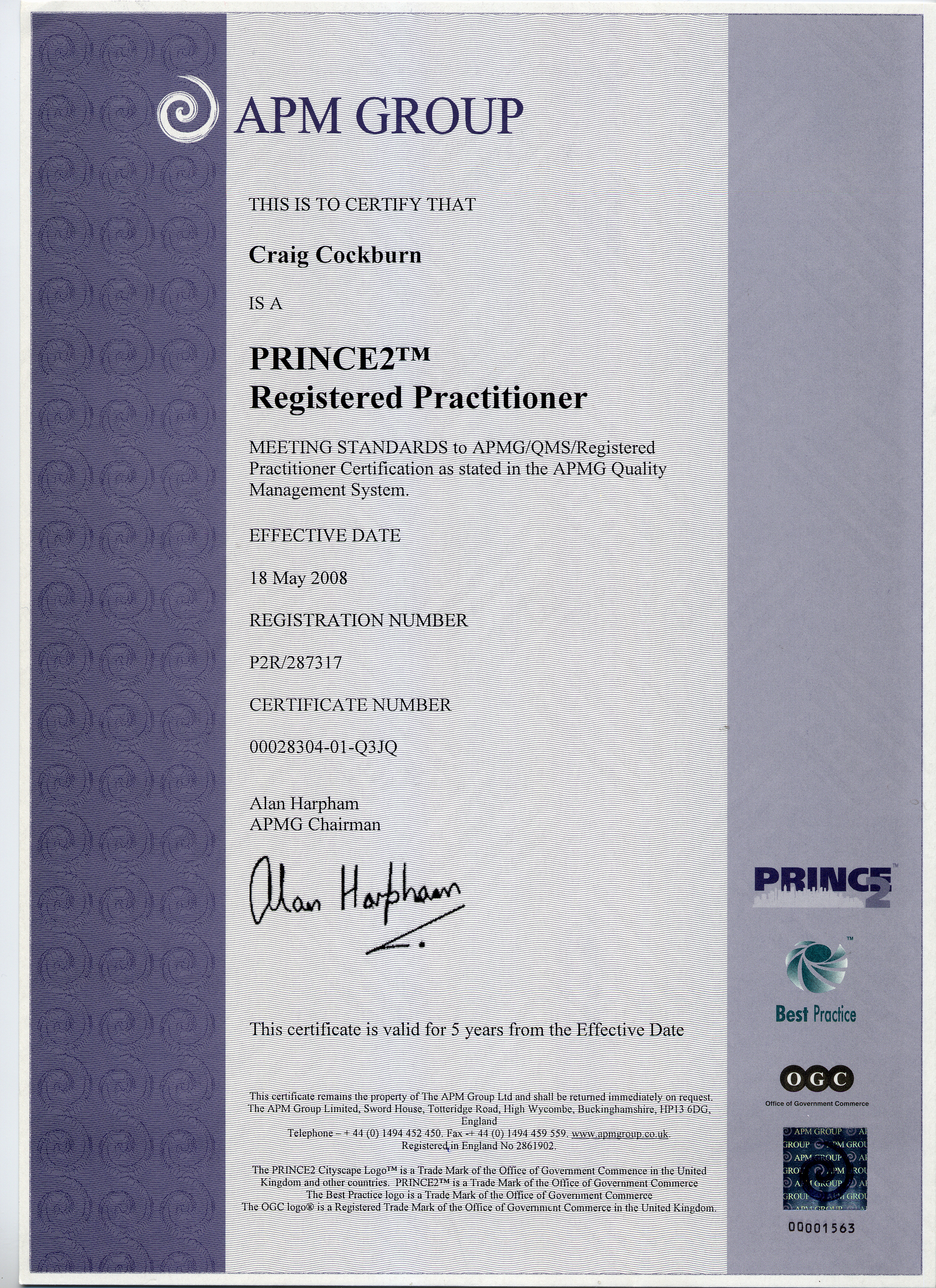
PRINCE2 Practitioner
I am a certified PRINCE2 Practitioner if anyone knows of any current jobs (pref contracts) on the go just now in the UK.
Alternatively, if you want commission for referring me, you can do so via Zubka
See also the PRINCE2 group on LinkedIn.
Craig
Alternatively, if you want commission for referring me, you can do so via Zubka
See also the PRINCE2 group on LinkedIn.
Craig
08 June 2008
Government CIO demands Green best practice
Government CIO, John Suffolk, demands Green best practice for IT.
That being the case, why is it that all the government jobs I go for, not one has suggested that the interview is held via webcam (which I could do from my house) or even via hi-def video link (which you think I ought to be able to do from a government office in Edinburgh for an interview in London.
Come to think of it, why have none of the dot.com companies I've interviewed for suggested this either? OK to be a trendy dot com Web2.0 company using people on the Internet from all over the world to make your company a success, but still stuck in the mindset that employees all need to be in the same room?
Is it acceptable to have a day trip in a plane to physically attend an interview when the technology is adequate to see what I look like?
Besides the environmental impact, it would save me approx £200 in costs. I'm sure if the government were paying these costs for a permanent position, the tax payer would save in terms of reduced government costs and the environment would also benefit.
So why does noone seem to want to offer video interviews? Surely this is an easy first step to Green IT as the technology has already been around for years.
Craig
That being the case, why is it that all the government jobs I go for, not one has suggested that the interview is held via webcam (which I could do from my house) or even via hi-def video link (which you think I ought to be able to do from a government office in Edinburgh for an interview in London.
Come to think of it, why have none of the dot.com companies I've interviewed for suggested this either? OK to be a trendy dot com Web2.0 company using people on the Internet from all over the world to make your company a success, but still stuck in the mindset that employees all need to be in the same room?
Is it acceptable to have a day trip in a plane to physically attend an interview when the technology is adequate to see what I look like?
Besides the environmental impact, it would save me approx £200 in costs. I'm sure if the government were paying these costs for a permanent position, the tax payer would save in terms of reduced government costs and the environment would also benefit.
So why does noone seem to want to offer video interviews? Surely this is an easy first step to Green IT as the technology has already been around for years.
Craig
02 June 2008
The crowdsourcing revolution, users get paid?
In a recent evaluation of some social networking sites, we find that many sites are valued in the $20-$25 per user range for a one off purchase.
On that basis, and the traffic from this site based on unique users, that's me back to being a dot com (dollar) millionaire again then. However, finding a buyer is another matter.
Seriously though, I am rather surprised at the economic model at work here.
1. Clever programmers write some website software. If you're in the UK you're unlikely to get stock options for this.
2. Said website goes onto become hugely successful, clever programmers don't usually get to become millionaires based on this (bebo being one of the few UK exceptions).
3. Said website is then based on active users, who contribute content. This content then drives further user activity fostering a community some of which has commercial value in the form of advertising. Millions of users contributing content = crowdsourcing. Users build up the site "for free" rather than the pre Web 2.0 days of a company having to pay a 3rd party to do it.
We've moved from the Web1.0 days when you needed to pay content editors to have good content on your site (about.com) to Web2.0 when with a decent site site owners get this content for free. So what's next? I would suggest the next economic revolution on the net is that rather than taking the users for a free ride, they should be paid back in shares based on a proportion of the advertising revenue that their content generates. Then when the company is sold, they get cash for those shares and a reward for having built the site up rather than nothing in the way of a financial thank-you for making the site a success.
There's no such thing as a free lunch and personally I am rather surprised at the hundreds of hours people spend on social networking sites, building up value in those sites for a tiny number of shareholders who walk away with 9 figure payouts and the users who created that wealth getting nothing in return.
Crowdsourcing isn't that new, Adam Smith wrote in 1776 in the founding work of economics the wealth of nations that "the division of labour is the source of economic growth". So what about a fair day's wage for a fair day's work in 2008 then? Profit sharing plans for employees are nothing new in the US although still something of a novelty in the UK, is it such a stretch to extend this concept of profit sharing out to crowdsourced content creators?
People aren't slaves. They shouldn't expect to work for nothing. If the contributors to these sites simply downed tools and said "no more contributions until I get paid for them", the Internet would perhaps turn into a different place with more money being distributed out to the original content creators and less of it being sucked into the middle and the search engines that serve up advertising.
Who do you think is more worthy of being paid?
Is this the new economy?
Craig (posting to his own site).
On that basis, and the traffic from this site based on unique users, that's me back to being a dot com (dollar) millionaire again then. However, finding a buyer is another matter.
Seriously though, I am rather surprised at the economic model at work here.
1. Clever programmers write some website software. If you're in the UK you're unlikely to get stock options for this.
2. Said website goes onto become hugely successful, clever programmers don't usually get to become millionaires based on this (bebo being one of the few UK exceptions).
3. Said website is then based on active users, who contribute content. This content then drives further user activity fostering a community some of which has commercial value in the form of advertising. Millions of users contributing content = crowdsourcing. Users build up the site "for free" rather than the pre Web 2.0 days of a company having to pay a 3rd party to do it.
We've moved from the Web1.0 days when you needed to pay content editors to have good content on your site (about.com) to Web2.0 when with a decent site site owners get this content for free. So what's next? I would suggest the next economic revolution on the net is that rather than taking the users for a free ride, they should be paid back in shares based on a proportion of the advertising revenue that their content generates. Then when the company is sold, they get cash for those shares and a reward for having built the site up rather than nothing in the way of a financial thank-you for making the site a success.
There's no such thing as a free lunch and personally I am rather surprised at the hundreds of hours people spend on social networking sites, building up value in those sites for a tiny number of shareholders who walk away with 9 figure payouts and the users who created that wealth getting nothing in return.
Crowdsourcing isn't that new, Adam Smith wrote in 1776 in the founding work of economics the wealth of nations that "the division of labour is the source of economic growth". So what about a fair day's wage for a fair day's work in 2008 then? Profit sharing plans for employees are nothing new in the US although still something of a novelty in the UK, is it such a stretch to extend this concept of profit sharing out to crowdsourced content creators?
People aren't slaves. They shouldn't expect to work for nothing. If the contributors to these sites simply downed tools and said "no more contributions until I get paid for them", the Internet would perhaps turn into a different place with more money being distributed out to the original content creators and less of it being sucked into the middle and the search engines that serve up advertising.
Who do you think is more worthy of being paid?
Is this the new economy?
Craig (posting to his own site).
30 May 2008
PRINCE2 on LinkedIn
Please visit this link. I used to run a PRINCE2 group on LinkedIn, but have now closed it (no point in duplication)
Craig
Craig
26 May 2008
Estate agents, time to change business model
Unsurprisingly estate agents are feeling the pain of the credit crunch, with 150 closing a week and monthly sales down from 14 to 7 properties on average. This is despite Scottish house prices continuing to rise.
The problem here is twofold. First of all with agencies closing, there is fewer competition for consumers and secondly the remaining competition will no doubt carry on with the same absurd practices which led their competitors to go bust on the hope that it won't happen to them.
When I received a quote from some local estate agents, I was alarmed that the rates they quoted of 0.75% and 1% of the sale price were at the lower end of the national average which according to this article is about 2%. Using the national average house price of £218,112 and the figures above, here's an estate agent income calculator:
1. Average house price = £218,112
2. Average estate agent commission = 2% = £4,362 commission
3. Average monthly sales = 7. Therefore average monthly income = £30,535
4 Estate agents per office average, average salary £50,000. Total wages bill approx £18,000. This means approx £12,000 per month profit to cover phone calls, office hire and so on.
Certainly in my case, advertising and other extras such as placement on websites, noticeboards and so on was paid for on top.
So what did I get for my 1% deduction on the sale price, according to the bill? "Professional charges including preparation of draft schedule, validated and printed, insertion of photo in local offices, placement on rightmove website and dealing with enquiries".
For that they get 1% of the sale price, and sole selling rights which mean:
"If missives for the sale of the property are concluded during the period in which the company has sole selling rights then the charges are payable even if the buyer was found by myself".
So basically the current estate agent model means that even if I find a buyer, they get to charge 1% of the sale price. Personally I think this is an undue benefit to the agent and as such possibly unfair (and therefore illegal and unenforceable) however the point here is that it's a huge commission when you consider the actual effort to achieve it. To sell a property for 400K for instance, there isn't a lot of actual effort the agent needs to do besides place adverts in papers and on websites and for that they get £4K+, something that I could employ a full time consultant for a week and still have spare change, yet the estate agent sits back for the calls and gets the money even if I find the buyer. Surely something wrong here.
This is essentially why so many agents are now going bust, and why so many went bust in the previous housing downturn in England in the early 90s. They are dependent on a very small number of very high profit margin sales and so they are extremely vulnerable to market fluctuations and in a quiet period, their profits can dry up very quickly indeed.
The solution naturally is to pay estate agents a proper fee. I would quite happily pay £100 to write a schedule and take photos. I would also, maybe, pay to advertise on websites although I think that the age of having to do so will pass in the next 5 years as more free listing sites emerge. I also don't mind paying to advertise in local papers if necessary or on a per viewing basis if the agent shows the house for sale. However, I object to paying £4K just for them answering the phone when I could do it myself.
So all in it should be perfectly possible to sell a house whatever its market value for a few hundred pounds + whatever extra marketing I want to pay for. The days of taking 1%, 2% of the sale price should be a thing of the past.
This of course means that estate agents have even less money coming in which means that they have to deal with a much wider customer base. Fair enough, I think that there are probably too many estate agents and if the numbers stay at their post-crash lows then this would be a good thing. By having more customers and a lower margin on each, they would overall make more money due to scale and also would be more immune to market fluctuations
e.g. selling 100 properties a month over a much wider customer base and making £500 on each means that the agent makes £50,000 per month rather than £30,000 and having the customers spread over a wider area means they are less vulnerable to local downturns. Incidentally £500 is the min fee that my agent charged, so clearly it is feasible at this level.
Am I the only one who thinks its time for a shake up in how house sales are charged?
Evidently not, see House Network. Any more like it?
Craig
The problem here is twofold. First of all with agencies closing, there is fewer competition for consumers and secondly the remaining competition will no doubt carry on with the same absurd practices which led their competitors to go bust on the hope that it won't happen to them.
When I received a quote from some local estate agents, I was alarmed that the rates they quoted of 0.75% and 1% of the sale price were at the lower end of the national average which according to this article is about 2%. Using the national average house price of £218,112 and the figures above, here's an estate agent income calculator:
1. Average house price = £218,112
2. Average estate agent commission = 2% = £4,362 commission
3. Average monthly sales = 7. Therefore average monthly income = £30,535
4 Estate agents per office average, average salary £50,000. Total wages bill approx £18,000. This means approx £12,000 per month profit to cover phone calls, office hire and so on.
Certainly in my case, advertising and other extras such as placement on websites, noticeboards and so on was paid for on top.
So what did I get for my 1% deduction on the sale price, according to the bill? "Professional charges including preparation of draft schedule, validated and printed, insertion of photo in local offices, placement on rightmove website and dealing with enquiries".
For that they get 1% of the sale price, and sole selling rights which mean:
"If missives for the sale of the property are concluded during the period in which the company has sole selling rights then the charges are payable even if the buyer was found by myself".
So basically the current estate agent model means that even if I find a buyer, they get to charge 1% of the sale price. Personally I think this is an undue benefit to the agent and as such possibly unfair (and therefore illegal and unenforceable) however the point here is that it's a huge commission when you consider the actual effort to achieve it. To sell a property for 400K for instance, there isn't a lot of actual effort the agent needs to do besides place adverts in papers and on websites and for that they get £4K+, something that I could employ a full time consultant for a week and still have spare change, yet the estate agent sits back for the calls and gets the money even if I find the buyer. Surely something wrong here.
This is essentially why so many agents are now going bust, and why so many went bust in the previous housing downturn in England in the early 90s. They are dependent on a very small number of very high profit margin sales and so they are extremely vulnerable to market fluctuations and in a quiet period, their profits can dry up very quickly indeed.
The solution naturally is to pay estate agents a proper fee. I would quite happily pay £100 to write a schedule and take photos. I would also, maybe, pay to advertise on websites although I think that the age of having to do so will pass in the next 5 years as more free listing sites emerge. I also don't mind paying to advertise in local papers if necessary or on a per viewing basis if the agent shows the house for sale. However, I object to paying £4K just for them answering the phone when I could do it myself.
So all in it should be perfectly possible to sell a house whatever its market value for a few hundred pounds + whatever extra marketing I want to pay for. The days of taking 1%, 2% of the sale price should be a thing of the past.
This of course means that estate agents have even less money coming in which means that they have to deal with a much wider customer base. Fair enough, I think that there are probably too many estate agents and if the numbers stay at their post-crash lows then this would be a good thing. By having more customers and a lower margin on each, they would overall make more money due to scale and also would be more immune to market fluctuations
e.g. selling 100 properties a month over a much wider customer base and making £500 on each means that the agent makes £50,000 per month rather than £30,000 and having the customers spread over a wider area means they are less vulnerable to local downturns. Incidentally £500 is the min fee that my agent charged, so clearly it is feasible at this level.
Am I the only one who thinks its time for a shake up in how house sales are charged?
Evidently not, see House Network. Any more like it?
Craig
25 May 2008
DVD forced advertising hell

This picture sums up my attitude towards forced advertising and anti-skip menus on legitimate DVDS
21 May 2008
Independent Scotland: £4Bn budget surplus
SOARING oil prices would give an independent Scotland a £4.4 billion budget surplus, making it one of Europe's richest countries, according to a new study.
The surplus would allow Alex Salmond to maintain existing levels of public spending, while cutting corporation tax from 28% to 12.5%, reducing income tax by 5p in the pound and still having £2 billion every year to invest in a Norwegian-style oil fund to safeguard Scotland against a future decline in North Sea oil revenue.
The study, based on Treasury oil revenue forecasts and official spending figures, has calculated that, without money from the taxation of oil and gas, an independent Scotland would have an underlying deficit of £7.8billion. But when £12.2billion of oil and gas revenues are included, Scotland would have a surplus of more than £4billion.
See the link for more info
The surplus would allow Alex Salmond to maintain existing levels of public spending, while cutting corporation tax from 28% to 12.5%, reducing income tax by 5p in the pound and still having £2 billion every year to invest in a Norwegian-style oil fund to safeguard Scotland against a future decline in North Sea oil revenue.
The study, based on Treasury oil revenue forecasts and official spending figures, has calculated that, without money from the taxation of oil and gas, an independent Scotland would have an underlying deficit of £7.8billion. But when £12.2billion of oil and gas revenues are included, Scotland would have a surplus of more than £4billion.
See the link for more info
13 May 2008
11 May 2008
A tale of two websites
Having blogged about a more flexible e-commerce model for e-commerce before let me recap with some history.
The pioneers of e-commerce back in 1995 were Amazon and eBay. Both used a model that now forms the default business model replicated on nearly every other website. That is, you must register on the website and hold an account on the website with a login and password for you to buy anything. This is completely unnecessary, an invasion of users' privacy, does not help in any anti-fraud measures and is simply websites forcing users to hand over long term purchasing stats because they can rather than because it is an integral part of the transaction. We wouldn't tolerate this intrusiveness on the high street and we freely shop there without having to register with shops first, so why put up with this nonsense online?
This forced registration is excess data gathering and contravenes the third principle of the data protection act, namely that the information being handed over - the customer's buying history - is excessive for the purposes of the individual transaction. Sure it's convenient to have an account already set up if I don't want to enter my data repeatedly, but on the other hand it's really inconvenient having my every purchase tracked, and trying to log in when I'm required to have an account have forgotten the password and hate having yet another website where I have to remember yet another username and password.
Argos, a top 5 retail site in the UK is now bucking this 13 year old trend. You can register if you want to, but you don't have to. Well done Argos. Same goes for Visitscotland.com
Let me tell now the tale of two websites. When trying to buy a Chiminea Barbeque tonight, I found two very similar models at the same price.
One was on greenfingers.com which insisted I had an account or registered first, then when I went to register it said I couldn't because I already had even though when I went through the 10 minute forgotten password dance and logged in there was no account info there. The other was castironchimineas.co.uk which didn't require me to register and as an added triple bonus didn't have the other usual website irritations such as a mandatory courtesy title, needlessly separate first and last name fields (i.e. one field for the whole customer name) and finally allowed Scotland as a valid country. Naturally the latter site got my business, it was far simpler and easier to use.
Well done, castironchimineas, someone taking a leaf out of my book not only on flexible e-commerce, but also how to capture a customer name but also website usability guru Jakob Nielsen who said way back in 1995 that customer name fields should be combined into one.
Maybe 13 years after the e-commerce revolution started, we can start to get back to the basics of usability?
Craig
The pioneers of e-commerce back in 1995 were Amazon and eBay. Both used a model that now forms the default business model replicated on nearly every other website. That is, you must register on the website and hold an account on the website with a login and password for you to buy anything. This is completely unnecessary, an invasion of users' privacy, does not help in any anti-fraud measures and is simply websites forcing users to hand over long term purchasing stats because they can rather than because it is an integral part of the transaction. We wouldn't tolerate this intrusiveness on the high street and we freely shop there without having to register with shops first, so why put up with this nonsense online?
This forced registration is excess data gathering and contravenes the third principle of the data protection act, namely that the information being handed over - the customer's buying history - is excessive for the purposes of the individual transaction. Sure it's convenient to have an account already set up if I don't want to enter my data repeatedly, but on the other hand it's really inconvenient having my every purchase tracked, and trying to log in when I'm required to have an account have forgotten the password and hate having yet another website where I have to remember yet another username and password.
Argos, a top 5 retail site in the UK is now bucking this 13 year old trend. You can register if you want to, but you don't have to. Well done Argos. Same goes for Visitscotland.com
Let me tell now the tale of two websites. When trying to buy a Chiminea Barbeque tonight, I found two very similar models at the same price.
One was on greenfingers.com which insisted I had an account or registered first, then when I went to register it said I couldn't because I already had even though when I went through the 10 minute forgotten password dance and logged in there was no account info there. The other was castironchimineas.co.uk which didn't require me to register and as an added triple bonus didn't have the other usual website irritations such as a mandatory courtesy title, needlessly separate first and last name fields (i.e. one field for the whole customer name) and finally allowed Scotland as a valid country. Naturally the latter site got my business, it was far simpler and easier to use.
Well done, castironchimineas, someone taking a leaf out of my book not only on flexible e-commerce, but also how to capture a customer name but also website usability guru Jakob Nielsen who said way back in 1995 that customer name fields should be combined into one.
Maybe 13 years after the e-commerce revolution started, we can start to get back to the basics of usability?
Craig
Labour's fortunes
As if things weren't already bad enough for Gordon Brown, this week sees revelations from both Cherie Blair and John Prescott which are entirely unhelpful for Gordon Brown's image and popularity. It's also looking like Labour will also lose the forthcoming by-election, previously a safe Labour seat.
For a government that was so obsessed with spin and image whilst Tony Blair was in power, the publication of these memoirs is clearly something that serves the interests of the authors and who clearly also appreciates the damage it will do to the party as they seek a record breaking 4th successive term.
Clearly they have their own financial interests ahead of such an achievement for the Labour party and would rather be doing their bit to get the Tories elected in 2010 than hold off for a couple of years. An author's fortune or Labour's fortunes?
Coming in 2010. My years with Tony Blair and how my muck raking in 2008 led to Labour's defeat at the polls.
Somehow I don't think that'll be a best seller, unless published by Conservative central office
Craig
For a government that was so obsessed with spin and image whilst Tony Blair was in power, the publication of these memoirs is clearly something that serves the interests of the authors and who clearly also appreciates the damage it will do to the party as they seek a record breaking 4th successive term.
Clearly they have their own financial interests ahead of such an achievement for the Labour party and would rather be doing their bit to get the Tories elected in 2010 than hold off for a couple of years. An author's fortune or Labour's fortunes?
Coming in 2010. My years with Tony Blair and how my muck raking in 2008 led to Labour's defeat at the polls.
Somehow I don't think that'll be a best seller, unless published by Conservative central office
Craig
10 May 2008
Bring it on
In three unprepared words in a throwaway phrase, Labour has removed the biggest obstacle to democratic choice in Scotland: Whether the Scots should be allowed to decided whether or not to remain part of the UK
With those three words, the political process to make the biggest change to the UK for 300+ years really begins in earnest. A process which could see a large portion of the Scottish cabinet lose their seats post 2011, if the Tories haven't done the job first in 2010.
Bring it on indeed.
With those three words, the political process to make the biggest change to the UK for 300+ years really begins in earnest. A process which could see a large portion of the Scottish cabinet lose their seats post 2011, if the Tories haven't done the job first in 2010.
Bring it on indeed.
07 May 2008
London curry
Lahore Kebabhouse, E1 1PY
Excellent food and service. Great prices, no pretentiousness. No mandatory tipping or service charge either.
Only slight drawback is that it's yet another place that has a VAT number but doesn't issue correct VAT receipts (with the amount of actual VAT paid on them).
Here's the link Lahore Kebabhouse.
There's also some rather excellent curry to be had at the Noor Jahan 2, 26 Sussex Place, London W2 2TH but again is let down by the inability to produce a correct VAT receipt showing the VAT paid, meaning that the tip amount gets paid to the VATman rather than the staff. Food is excellent here though and there is also a very good pub just across the road, the Victoria at 10a Strathearn Place which has great food (stops at 9:30pm) and great beer. Busy on Tuesday evenings in the pub. Anywhere that gets 5 pints on Fancyapint.com is worth a visit.
Craig
Excellent food and service. Great prices, no pretentiousness. No mandatory tipping or service charge either.
Only slight drawback is that it's yet another place that has a VAT number but doesn't issue correct VAT receipts (with the amount of actual VAT paid on them).
Here's the link Lahore Kebabhouse.
There's also some rather excellent curry to be had at the Noor Jahan 2, 26 Sussex Place, London W2 2TH but again is let down by the inability to produce a correct VAT receipt showing the VAT paid, meaning that the tip amount gets paid to the VATman rather than the staff. Food is excellent here though and there is also a very good pub just across the road, the Victoria at 10a Strathearn Place which has great food (stops at 9:30pm) and great beer. Busy on Tuesday evenings in the pub. Anywhere that gets 5 pints on Fancyapint.com is worth a visit.
Craig
02 May 2008
Nokia N95 unable to display message
I like the Nokia N95, the GPS is useful as is the unlimited internet access I have on it. The speakers deliver a pretty decent quality for a phone when I'm playing MP3s, free entertainment in the hotel bedroom when I'm travelling.
However, the most consistently annoying thing is that about half the e-mails I receive immediately present the error "unable to display message" when opening the message and then "Conversion error" when the message is opened. I then have to open the HTML attachment to see the contents, which is obviously nice to look at but since I'm using a browser, the email function of "reply" is no longer available.
What's stranger is that if I do press reply without opening the attachment, there is the text content of the message which a few seconds ago the phone reported it couldn't display because of the conversion error and was unable to display the message as a result of said "conversion error".
Is there a solution to this problem or a known cause? After all, if the phone can read the contents to show them when replying why is it presenting the message when the mail is opened?
thanks
Craig
However, the most consistently annoying thing is that about half the e-mails I receive immediately present the error "unable to display message" when opening the message and then "Conversion error" when the message is opened. I then have to open the HTML attachment to see the contents, which is obviously nice to look at but since I'm using a browser, the email function of "reply" is no longer available.
What's stranger is that if I do press reply without opening the attachment, there is the text content of the message which a few seconds ago the phone reported it couldn't display because of the conversion error and was unable to display the message as a result of said "conversion error".
Is there a solution to this problem or a known cause? After all, if the phone can read the contents to show them when replying why is it presenting the message when the mail is opened?
thanks
Craig
29 April 2008
Website reviews
I'm going to enjoy slagging off a few websites at http://www.reviewcentre.com/, especially next.co.uk who have about the most user hostile website I have ever used.
Let me just say that any website that doesn't use passwords by trying to do things its own way is off to a very bad start indeed. Mandatory dates of birth when they aren't selling age related goods and all I want to do is just pay by credit card is also questionable under the data protection act, 3rd principle.
So if I can buy age related goods on amazon.co.uk without telling them my actual date of birth, merely that I am old enough why do I need to hand over material for ID theft when I buy on next and they don't sell age related goods?
Craig
Let me just say that any website that doesn't use passwords by trying to do things its own way is off to a very bad start indeed. Mandatory dates of birth when they aren't selling age related goods and all I want to do is just pay by credit card is also questionable under the data protection act, 3rd principle.
"Personal data shall be adequate, relevant and not excessive in relation to the purpose or purposes for which they are processed". The wide definition of processing should be borne in mind when considering the Third Principle. In complying with this Principle, data controllers should seek to identify the minimum amount of information that is required in order properly to fulfil their purpose and this will be a question of fact in each case. If it is necessary to hold additional information about certain individuals, such information should only be collected and recorded in those cases."
So if I can buy age related goods on amazon.co.uk without telling them my actual date of birth, merely that I am old enough why do I need to hand over material for ID theft when I buy on next and they don't sell age related goods?
Craig
27 April 2008
basic search engine failure
Why is it that 14 years after search engines took off, and millions of pounds of research later that in 2008 you still can't do something as basic and necessary as typing in your postcode to find out where the nearest chemist is that opens on a Sunday?
Even the NHS don't publish this info online, yet somehow they manage to give it to their contact centre staff. Staff who require to know your name, address and date of birth to answer a query.
How is this data collection justifiable when the information should be freely available online?
You can't search for post offices open on a Sunday either!
Craig
Even the NHS don't publish this info online, yet somehow they manage to give it to their contact centre staff. Staff who require to know your name, address and date of birth to answer a query.
How is this data collection justifiable when the information should be freely available online?
You can't search for post offices open on a Sunday either!
Craig
Better business regulation
I've submitted a few ideas to the better regulation website. If you want to cut red tape in business and improve productivity, why don't you do likewise?
Craig
Craig
The three rules of test driven development
A useful first step in proving the functionality of software, websites etc. Now all we need is a link up to ensure that the unit tests ensure what is being tested is actually what the end-user (as opposed to the customer) actually wants to use.
Craig
Craig
26 April 2008
Tesco, every little helps
Every Friday night when I get back from work about 11pm, the shops have long since closed. The local shops all have lights out, the businesses all have lights out and the only store with lights on is the local Tesco.
Every light on, plain as day, just as if the store was open and full of customers. Yet, the store has been shut for an hour. No dimmer switch, not even just some of them on. Even the staff canteen lights are on long after the staff have left.
Tesco, you are constantly going on about how green you are and isn't it wonderful that your store in Wick is powered by renewable energy and how we'll get green points if we reuse our carrier bags and all that stuff. I actually reuse my carrier bags, I use them instead of bin bags meaning that I don't need to buy use-once bin bags. Back to the point though. Do you not think you might save on the 4.13m tonnes of carbon you eject into the atmosphere every year if you did one simple thing?
TURN OFF THE LIGHTS WHEN THE STORE IS SHUT
You know, like every one else is told to do. Or is your store security more important than the environment?
Remember Tesco, every little helps.
Craig
Every light on, plain as day, just as if the store was open and full of customers. Yet, the store has been shut for an hour. No dimmer switch, not even just some of them on. Even the staff canteen lights are on long after the staff have left.
Tesco, you are constantly going on about how green you are and isn't it wonderful that your store in Wick is powered by renewable energy and how we'll get green points if we reuse our carrier bags and all that stuff. I actually reuse my carrier bags, I use them instead of bin bags meaning that I don't need to buy use-once bin bags. Back to the point though. Do you not think you might save on the 4.13m tonnes of carbon you eject into the atmosphere every year if you did one simple thing?
TURN OFF THE LIGHTS WHEN THE STORE IS SHUT
You know, like every one else is told to do. Or is your store security more important than the environment?
Remember Tesco, every little helps.
Craig
25 April 2008
Scottish IT consultation with Enterprise minister
At an industry consultation earlier this week, ScotlandIS Members, including myself, met with the Enterprise Minister, Jim Mather. Issues raised included the increasing difficulty in accessing public sector contracts, the contribution the industry can make in helping to grow the economy, and the skills challenges the industry faces.
For more details including the White Paper prepared for the Industry Consultation see the page on the ScotlandIS site.
Craig
For more details including the White Paper prepared for the Industry Consultation see the page on the ScotlandIS site.
Craig
22 April 2008
Paddington Tandoori
Paddington tandoori
Gloucester terrace, London
Gloucester terrace, London
Avoid. Cash only, mandatory tip and no VAT receipt. Eat elsewhere.
Why do so many businesses rip off consumers with mandatory charges and incompetent billing?
20 April 2008
Paypal's contender for most irritating and misleading information on the Internet
If you have a Paypal account linked to a bank account (i.e. so that you can withdraw money) then you are greeted with this abomination every time you attempt to pay by a credit card:

It's the default option to pay by bank account and you can't change it. However, I wonder if enough people wrote to customercare@paypal.com and asked them to change this spurious policy they might change their mind. When I want to spend my money, I'd like the option of specifying which account is debited by default, especially if I ever pay by mobile phone the contortions you have to go to to change the payment method from the default are a major pain. As someone with a bit of e-commerce experience (E-commerce lead for Scotland's tourism portal and Project Manager for Tesco.com grocery) I'd like to think that the laughable reasons Paypal gives could do with a bit of comment.
Paypal's text:
My response: Indeed, however since paying with cash isn't an online option this is rather a bogus comparison, no? Paying with a credit or debit card of course is also instant as paypal gets an authorisation code when I pay with a credit or debit card, therefore the vendor can dispatch the goods immediately. No different to paying with a debit or credit card in a shop, as opposed to handing over my banking details there. Furthermore, if I could pay with cash online it wouldn't be as easy because then I wouldn't benefit from any Paypal or credit card protection would I?
Paypal statement:
My response: I hope you're not implying that my other info, such as my card details, isn't held to the same exacting standards? Which military-grade encryption would that happen to be by the way, Ancient Roman Army encryption of letter transposition or 256 bit AES? 100% coverage of any unauthorised use eh, you mean just like all the credit cards I have?
Paypal statemet:
My response: This isn't easy at all. I want to make withdrawals to my bank account so that I can spend the money. I want to make payments from a credit card so not only do I benefit from up to 7 weeks interest free credit and have a few weeks notice of any fraud hitting my actual bank account when the payment is due, I also don't want to use my business bank account for payments because being a business bank account it is charged per transaction fees whereas my credit card is not. So, using the same account for payments and withdrawals isn't easy at all, in fact you trying to make me use the same account for both is a major pain in the arse.
Let me now redo the screen to say what Paypal is probably wanting to write
Which does strike me as rather odd, especially since I can go onto numerous websites and legally download MP3s for as little as 79p. Clearly these sites not only have to cover the artists' licensing costs and their own profits but also any credit card processing charges which let's face it must be pretty minuscule. Indeed, companies such as Protx offer flat rate transactions of 10p for high volume users and the kind reader is referred to realbusiness or even an article I wrote for further info on credit card charges and the options available.
So come on Paypal, come clean with customers and give us some choice instead of bogus excuses please. After all, it's our money.
thanks
Craig
p.s. I wonder if Paypal presents the same bogus arguments when you try to pay with one of their own branded credit cards?

It's the default option to pay by bank account and you can't change it. However, I wonder if enough people wrote to customercare@paypal.com and asked them to change this spurious policy they might change their mind. When I want to spend my money, I'd like the option of specifying which account is debited by default, especially if I ever pay by mobile phone the contortions you have to go to to change the payment method from the default are a major pain. As someone with a bit of e-commerce experience (E-commerce lead for Scotland's tourism portal and Project Manager for Tesco.com grocery) I'd like to think that the laughable reasons Paypal gives could do with a bit of comment.
Paypal's text:
Before deciding to fund your payment with a debit or credit card, consider the benefits of paying with your bank account.
Paying with your bank account is instant and your payment will be completed immediately, as easy as paying with cash
My response: Indeed, however since paying with cash isn't an online option this is rather a bogus comparison, no? Paying with a credit or debit card of course is also instant as paypal gets an authorisation code when I pay with a credit or debit card, therefore the vendor can dispatch the goods immediately. No different to paying with a debit or credit card in a shop, as opposed to handing over my banking details there. Furthermore, if I could pay with cash online it wouldn't be as easy because then I wouldn't benefit from any Paypal or credit card protection would I?
Paypal statement:
Paypal keeps your bank account information safe and secure through military-grade encryption and 100% coverage of any unauthorised use.
My response: I hope you're not implying that my other info, such as my card details, isn't held to the same exacting standards? Which military-grade encryption would that happen to be by the way, Ancient Roman Army encryption of letter transposition or 256 bit AES? 100% coverage of any unauthorised use eh, you mean just like all the credit cards I have?
Paypal statemet:
Easy - use the same bank account for making payments and withdrawals
My response: This isn't easy at all. I want to make withdrawals to my bank account so that I can spend the money. I want to make payments from a credit card so not only do I benefit from up to 7 weeks interest free credit and have a few weeks notice of any fraud hitting my actual bank account when the payment is due, I also don't want to use my business bank account for payments because being a business bank account it is charged per transaction fees whereas my credit card is not. So, using the same account for payments and withdrawals isn't easy at all, in fact you trying to make me use the same account for both is a major pain in the arse.
Let me now redo the screen to say what Paypal is probably wanting to write
Dear Customer, please pay using direct payment because it costs us less in fees.
Which does strike me as rather odd, especially since I can go onto numerous websites and legally download MP3s for as little as 79p. Clearly these sites not only have to cover the artists' licensing costs and their own profits but also any credit card processing charges which let's face it must be pretty minuscule. Indeed, companies such as Protx offer flat rate transactions of 10p for high volume users and the kind reader is referred to realbusiness or even an article I wrote for further info on credit card charges and the options available.
So come on Paypal, come clean with customers and give us some choice instead of bogus excuses please. After all, it's our money.
thanks
Craig
p.s. I wonder if Paypal presents the same bogus arguments when you try to pay with one of their own branded credit cards?
16 April 2008
All-hotels.com, no VAT
Be careful booking through all-hotels.com if you are a business. The prices may appear cheap, but they don't issue VAT invoices, this then means you don't get the usual 15% discount over the published rates. 15% = 100*(1-100/117.5) in case you were wondering.
There seems something rather odd about paying to stay in a hotel and there being no VAT due. Where did it go and who collected it?
Craig
There seems something rather odd about paying to stay in a hotel and there being no VAT due. Where did it go and who collected it?
Craig
14 April 2008
review of The Ganges, Paddington
Great food, lousy service.
the service really let down the fine efforts of the chef, be warned.
first of all, when I was asking about the menu, the waiter wandered off.
The main course was served while I was still eating the starter.
The empty plates from the starter were left on the table when I was eating the main course.
There was no fresh cutlery brought for the main course.
I wasnt asked at any point if the meal was ok or if I enjoyed it.
Receipt isnt a proper VAT bill, it has to show the amount of actual VAT paid, not just a total.
Service for the dessert and bill were slow.
Great food badly let down by shoddy service - just as well the service isn't included.
See what other diners thought by looking at the reviews at the following link: 
04 April 2008
Nokia N95 MAC Address
How to get the WLAN MAC Address for a Nokia N95 or Nokia E61
Enter this *#62209526#
Corresponds to this *#MAC WLAN#
Might be even more useful if it was in the phone's help.
Enter this *#62209526#
Corresponds to this *#MAC WLAN#
Might be even more useful if it was in the phone's help.
01 April 2008
Why I don't tip in restaurants
I haven't written a long blog in a while so I thought it was time to post this missive now that I've been living in London for 7 weeks.
I last tipped in a restaurant in December and I eat out 4 nights a week. So strictly speaking I do tip, when there's exceptional service and I want to say thanks (the last time was at Benedicts of Belfast) but so far I've been pretty unimpressed with London. Yet, some restaurants demand a 10% tip, there's no way to remove it from the bill and the service is pretty average.
I don't expect London to be cheap, but working in Whitehall, I can pop up the road from Downing Street and the Palace of Westminster and eat near the corner of Whitehall and Trafalgar Square at the Wetherspoons "Lord Moon of the Mall" for about a tenner including a drink. That's about as central as you can get, a stone's throw from where all the distances to London are measured and a few minutes walk from both the centre of government, theatreland, The Mall and The Strand. A decent (if somewhat basic) meal, a pint of beer and about a tenner. You pay at the bar so there's no tip added to the bill either.
Yet eat at a restaurant, even in more outlying areas such as Aldgate, Pimlico, Bayswater and so on and you'll usually pay over £20 for a meal for one in a restaurant for much the same meal. Eat in a pub, even a good one with "5 pints" on the website fancyapint.com and you get decent food, a drink and it's still around £10-£12. There's clearly a rip off market amongst restaurants who seem to think it's par for the course to whack on at least a 50% premium then look surprised when I don't want to pay the mandatory 10% surcharge on on top of that just because someone has carried a few plates 6 feet from the service hatch to my table then asked me if the meal was OK, cue reference to the "Maharaja Indian Restaurant", Queensway London which indulges in this nefarious practice.
Then you get the bill and have to ask for a VAT receipt. Usually this is some sort of semi-scribbled effort that if you're lucky has the total and the VAT number. Sorry, not good enough. Because goods are rated at different levels, in order to accurately know what the VAT amount is, you can't just guess that 17.5% was added on to the net amount. The receipt actually has to show the amount of VAT paid, just like the receipts I get when I shop in major supermarkets. So even if I was thinking of giving a tip for outstanding plate carrying to my table, the amount of tip I was going to leave has more than been eroded by the fact that the said restaurant is incapable of producing a proper VAT receipt with their VAT number on it, the total VAT paid and the total of the bill. There goes their "tip" - off to the VATman because of incompetency.
So if I get a square meal like I do in Benedicts of Belfast (the sort of food where people come from miles around to eat there) or even basic food such as Wetherspoons and pay £12 then I figure for a restaurant in an expensive area it's going to be around £15 including VAT, assuming I get a correct VAT receipt. I know it's economic to run a restaurant on that basis, the Lord Moon of the Mall in Whitehall shows it can be done for much less.
Any restaurant wanting £20 for the same and especially those with no VAT receipt have just used up my budget and gone over by a fiver. The tip has already been spent on overpriced food.
So that's what I don't tip (in London at least). It's so completely different in the US, where eating in restaurants is much cheaper, the portions are much bigger, the service better and you actually feel tipping is worthwhile and the server deserves it rather than in London where it's a surcharge on top of a rip off.
Comments?
I last tipped in a restaurant in December and I eat out 4 nights a week. So strictly speaking I do tip, when there's exceptional service and I want to say thanks (the last time was at Benedicts of Belfast) but so far I've been pretty unimpressed with London. Yet, some restaurants demand a 10% tip, there's no way to remove it from the bill and the service is pretty average.
I don't expect London to be cheap, but working in Whitehall, I can pop up the road from Downing Street and the Palace of Westminster and eat near the corner of Whitehall and Trafalgar Square at the Wetherspoons "Lord Moon of the Mall" for about a tenner including a drink. That's about as central as you can get, a stone's throw from where all the distances to London are measured and a few minutes walk from both the centre of government, theatreland, The Mall and The Strand. A decent (if somewhat basic) meal, a pint of beer and about a tenner. You pay at the bar so there's no tip added to the bill either.
Yet eat at a restaurant, even in more outlying areas such as Aldgate, Pimlico, Bayswater and so on and you'll usually pay over £20 for a meal for one in a restaurant for much the same meal. Eat in a pub, even a good one with "5 pints" on the website fancyapint.com and you get decent food, a drink and it's still around £10-£12. There's clearly a rip off market amongst restaurants who seem to think it's par for the course to whack on at least a 50% premium then look surprised when I don't want to pay the mandatory 10% surcharge on on top of that just because someone has carried a few plates 6 feet from the service hatch to my table then asked me if the meal was OK, cue reference to the "Maharaja Indian Restaurant", Queensway London which indulges in this nefarious practice.
Then you get the bill and have to ask for a VAT receipt. Usually this is some sort of semi-scribbled effort that if you're lucky has the total and the VAT number. Sorry, not good enough. Because goods are rated at different levels, in order to accurately know what the VAT amount is, you can't just guess that 17.5% was added on to the net amount. The receipt actually has to show the amount of VAT paid, just like the receipts I get when I shop in major supermarkets. So even if I was thinking of giving a tip for outstanding plate carrying to my table, the amount of tip I was going to leave has more than been eroded by the fact that the said restaurant is incapable of producing a proper VAT receipt with their VAT number on it, the total VAT paid and the total of the bill. There goes their "tip" - off to the VATman because of incompetency.
So if I get a square meal like I do in Benedicts of Belfast (the sort of food where people come from miles around to eat there) or even basic food such as Wetherspoons and pay £12 then I figure for a restaurant in an expensive area it's going to be around £15 including VAT, assuming I get a correct VAT receipt. I know it's economic to run a restaurant on that basis, the Lord Moon of the Mall in Whitehall shows it can be done for much less.
Any restaurant wanting £20 for the same and especially those with no VAT receipt have just used up my budget and gone over by a fiver. The tip has already been spent on overpriced food.
So that's what I don't tip (in London at least). It's so completely different in the US, where eating in restaurants is much cheaper, the portions are much bigger, the service better and you actually feel tipping is worthwhile and the server deserves it rather than in London where it's a surcharge on top of a rip off.
Comments?
31 March 2008
Credit Card Rip Off
Why is it that Easyjet rip me off with a £4.95 minimum credit card fee when I buy something on their site yet I can buy a downloaded MP3 on most UK websites for 79p for no credit card charge at all?
Anyone else feel this is a rip off?
Anyone else feel this is a rip off?
11 February 2008
Scotland's bridges are all toll free
The BBC reports that as of just over an hour ago Scotland no longer has any bridge tolls
It took a Labour government to sit on this suggestion for nearly 10 years and an SNP government less than 10 months to make it a reality. See my proposal for banning bridge tolls as they simply penalised the communities they serve.
This suggestion was made to the Labour government in November 1997. SNP, time for change. If only all governments were this effective.
It took a Labour government to sit on this suggestion for nearly 10 years and an SNP government less than 10 months to make it a reality. See my proposal for banning bridge tolls as they simply penalised the communities they serve.
This suggestion was made to the Labour government in November 1997. SNP, time for change. If only all governments were this effective.
02 February 2008
siliconglen.com, Scotland's Internet portal, for sale
I have owned and maintained the content on this site since 1999 and I would like to sell the site, contents, related domains, ongoing traffic etc so that I can work on other projects. The site is profitable, and ranks of the first page of Google results for a wide variety of Scottish business and cultural search terms. I did a list of some of the placements back in 2006 although they will have changed since then. However, more than that, siliconglen is the name synonymous with the Scottish IT sector in the way that Silicon Valley is for the US. The domain alone has a lot of potential for a trade body, a government body, business group, tourism site or a publisher to make into a genuine portal for Scotland. The term is widely used in the media and due to the name and search engine placement receives enquiries from the media and organisations interested in the region and wanting to invest here.
Serious enquiries only please to craig@siliconglen.com
many thanks
Craig
Serious enquiries only please to craig@siliconglen.com
many thanks
Craig
28 January 2008
Ageism is illegal. So why do the media make it such a focus?
On 1st October 2006, the UK enacted a law to make ageism illegal. This is only for employment but nonetheless, despite privacy concerns, many employment related websites still ask for it or some equivalent field such as "career start" under the guise of data de-duplication. Today being data privacy day it might be a good time to remind them to get their unique numbers another way.
Anyway, for those sites and application forms that still request it, they claim that it is to ensure compliance with the new legislation. Funny that, before the legislation you didn't have to supply such information, now some agencies ask for it and cite the legislation as the reason. Furthermore, as I blogged in 2006 you are now forced to reveal your age for ID purposes when applying for a job.
So that's the background. Age when applying for a job should just be recorded for "checking purposes" and to ensure that recruiters are playing fairly. In that regard, it is no different to race, religion and other profiling characteristics that are illegal (and immoral) to discriminate on. Yet, the rest of society hasn't really caught up.
Let's take a typical news story from today where the people's ages have no relevance.
The original text:
The text if we removed the profiling information and replaced it with ethnic origin (these are made up)
Completely irrelevant, pointless and bordering on racist.
Maybe you could have an alternate version using other profiling information such as religion
Again, fairly offensive, pointless and quite irrelevant.
So why do we continue to accept the pointless and irrelevant reporting of the number of birthdays someone has had when it has no relevance to the story? It is just as offensive and wrong as other profiling information that it is illegal to discriminate on.
Comments?
Anyway, for those sites and application forms that still request it, they claim that it is to ensure compliance with the new legislation. Funny that, before the legislation you didn't have to supply such information, now some agencies ask for it and cite the legislation as the reason. Furthermore, as I blogged in 2006 you are now forced to reveal your age for ID purposes when applying for a job.
So that's the background. Age when applying for a job should just be recorded for "checking purposes" and to ensure that recruiters are playing fairly. In that regard, it is no different to race, religion and other profiling characteristics that are illegal (and immoral) to discriminate on. Yet, the rest of society hasn't really caught up.
Let's take a typical news story from today where the people's ages have no relevance.
The original text:
By Andrew Hough and Michael Holden
LONDON (Reuters) - Five men were found guilty on Monday of kidnap and robbery in the country's biggest ever heist, a daring, 53 million pound raid on a cash depot in Kent.
The robbers, some dressed as policemen and most wearing prosthetic disguises, snatched the record haul after getting past tight security by kidnapping the depot's manager, his wife and son at gunpoint.
They were also helped by an "inside man", who not only provided details of the building's interior layout and security protocols, but also secretly filmed it using a tiny camera hidden on his belt.
Despite the elaborate planning, the gang was rounded up by police within days of the February 2006 raid at the Securitas Depot in Tonbridge, after detectives received a tip-off.
Stuart Royle, 49, Jetmir Bucpapa, 26, Lea Rusha, 35, Ermir Hysenaj, 28, and Roger Coutts, 30, were convicted at the Old Bailey of conspiracy to kidnap, conspiracy to rob and conspiracy to possess firearms.
Another defendant, John Fowler, 59, was cleared of those charges while Keith Borer, 54, was found not guilty of handling stolen goods.
The text if we removed the profiling information and replaced it with ethnic origin (these are made up)
LONDON (Reuters) - Five men were found guilty on Monday of kidnap and robbery in the country's biggest ever heist, a daring, 53 million pound raid on a cash depot in Kent.
...
Stuart Royle, black, Jetmir Bucpapa, white, Lea Rusha, asian, Ermir Hysenaj, black , and Roger Coutts, white, were convicted at the Old Bailey of conspiracy to kidnap, conspiracy to rob and conspiracy to possess firearms.
Another defendant, John Fowler, white, was cleared of those charges while Keith Borer, middle-eastern, was found not guilty of handling stolen goods.
Completely irrelevant, pointless and bordering on racist.
Maybe you could have an alternate version using other profiling information such as religion
LONDON (Reuters) - Five men were found guilty on Monday of kidnap and robbery in the country's biggest ever heist, a daring, 53 million pound raid on a cash depot in Kent.
...
Stuart Royle, catholic, Jetmir Bucpapa, muslim, Lea Rusha, protestant, Ermir Hysenaj, moslem, and Roger Coutts, athiest, were convicted at the Old Bailey of conspiracy to kidnap, conspiracy to rob and conspiracy to possess firearms.
Another defendant, John Fowler, Jew, was cleared of those charges while Keith Borer, protestant, was found not guilty of handling stolen goods.
Again, fairly offensive, pointless and quite irrelevant.
So why do we continue to accept the pointless and irrelevant reporting of the number of birthdays someone has had when it has no relevance to the story? It is just as offensive and wrong as other profiling information that it is illegal to discriminate on.
Comments?
PRINCE2 + AGILE = Common sense?
An article on how Agile can sit alongside PRINCE2 and where DSDM Atern fits in.
In 2007, I put "used an Agile/PRINCE2 development strategy" on my CV. It's been quite the conversation starter at interviews. So I thought it would be of interest to blog about it here and gauge the reaction/feedback.
First off PRINCE2 is an acronym for "PRojects IN Controlled Environments" (version 2). PRINCE2 is a generic project management method for exercising control over a project's startup through to closure (SU1 to DP5 for all you who enjoy punch card like references). It's a generic project management method that had its origins in IT but which now makes no reference to IT and could be used from anything from building a ship to planning your summer holiday. Whether you would want to use it on the latter is entirely up to you. The same flexibility of choice is not however accorded to the large number of public (and increasingly private) sector projects that use it since it is seen as the de-facto project management method and its use is frequently mandated, despite there being other methods that may be more relevant for the task in hand. There have also been a large number of complex and extensive government IT project failures recently many of which would have used PRINCE2 and which highlight that even a refined method such as PRINCE2 can run aground on large scale, long running projects that are subject to considerable change.
On paper, PRINCE2 is logical, reasonable and linear. However, as experience suggests - for example in the long series of failed UK Government IT projects where PRINCE2 is the mandated method - simply being logical, reasonable and linear, is not sufficient. It is not sufficient to make it the effective project management method business and public sector organisations really need."
From PRINCE2 problems by Business Transition Technologies
PRINCE2 is based around project control. Control is clearly a Good Thing, however being a generic method with no reference to IT, the closest IT development method would be the waterfall method, which is very well lampooned on the Waterfall2006 site. It is just these shortcomings of the waterfall method which seem to cause the biggest problems with PRINCE2 projects, especially those which due to their complexity and length of development are prone to large amounts of change. PRINCE2 also does not account for software projects comprising multiple versions and how these are handled, nor for website development and deployment which can be an almost continuous process.
Change is inevitable in projects. In response to this Agile development methods arose to deal with this change more effectively, particularly from a software engineering perspective and unlike PRINCE2, cover in detail the more day to day activities such as sprint planning, daily meeting structure etc. Agile does not have comprehensive cover for project management, however the Agile DSDM development method was developed with PRINCE in mind, as detailed in the paper using DSDM with PRINCE2 [PDF]. Thus the combination of Agile and PRINCE2 is not as contradictory as it might at first seem. One is a development method for managing change, the other is a project management method for exercising control, so the two compliment one another and should result in a management method for control in a changing environment. One can see from this white paper on integrating DSDM into a PRINCE2 environment [PDF] that at the actual delivery level the focus is much more on the agile processes rather than PRINCE2.
Alistair Cockburn (no relation) and others have produced a set of agile management methods however this has grown out of the agile community and consists of a set of principles rather than the sort of detailed how-to that would make it easy to sell to the PRINCE2 diehards.
The most complete agile project management method I have come across is DSDM Atern which is described as follows:
The description of DSDM Atern on amazon.co.uk explains further:
Atern is the leading, proven, agile approach providing the governance and rigour along with the agility and flexibility organisations demand today. It is also ideal as a wrapper for more limited agile approaches to ensure that the whole project lifecycle is addressed. Atern is a proven 'battle hardened approach' and has been responsible for the successful delivery of innumerable projects around the world. Its provenance across both IT and non-IT contexts goes back to 1994 with substantial productivity gains independently verified by the UK Software Metrics Association.
This is just intended as an overview to illustrate that PRINCE2 and Agile are not necessarily contradictory and that is possible to combine elements of both successfully, particularly when it comes to the managing a stage part of PRINCE2 - Agile turns this into many small stages comprising stable components of work suitable for release. However, what remains a mystery to me is why government departments have been so reluctant in the face of the number of IT failures I have blogged about to promote an agile implementation of PRINCE2 and how it can best be delivered for complex IT projects running into billions of pounds. DSDM Atern isn't necessarily suitable for all projects, but certainy for iteratively deployed projects which are happy to embrace change, it should be considered as a more suitable alternative to PRINCE2.
This whole sense approach to software development from project governance to day to day management would seem to be the holy grail for minimising such failures. Perhaps it is time to encourage those who mandate PRINCE2 to understand this in order to minimise further wastage.
Further reading on DSDM is available on the DSDM website and for discussions with the authors of DSDM, I would recommend the DSDM group on LinkedIn.
Craig
Update: in June 2011 I wrote an update covering Agile and PRINCE2.
In 2007, I put "used an Agile/PRINCE2 development strategy" on my CV. It's been quite the conversation starter at interviews. So I thought it would be of interest to blog about it here and gauge the reaction/feedback.
First off PRINCE2 is an acronym for "PRojects IN Controlled Environments" (version 2). PRINCE2 is a generic project management method for exercising control over a project's startup through to closure (SU1 to DP5 for all you who enjoy punch card like references). It's a generic project management method that had its origins in IT but which now makes no reference to IT and could be used from anything from building a ship to planning your summer holiday. Whether you would want to use it on the latter is entirely up to you. The same flexibility of choice is not however accorded to the large number of public (and increasingly private) sector projects that use it since it is seen as the de-facto project management method and its use is frequently mandated, despite there being other methods that may be more relevant for the task in hand. There have also been a large number of complex and extensive government IT project failures recently many of which would have used PRINCE2 and which highlight that even a refined method such as PRINCE2 can run aground on large scale, long running projects that are subject to considerable change.
On paper, PRINCE2 is logical, reasonable and linear. However, as experience suggests - for example in the long series of failed UK Government IT projects where PRINCE2 is the mandated method - simply being logical, reasonable and linear, is not sufficient. It is not sufficient to make it the effective project management method business and public sector organisations really need."
From PRINCE2 problems by Business Transition Technologies
PRINCE2 is based around project control. Control is clearly a Good Thing, however being a generic method with no reference to IT, the closest IT development method would be the waterfall method, which is very well lampooned on the Waterfall2006 site. It is just these shortcomings of the waterfall method which seem to cause the biggest problems with PRINCE2 projects, especially those which due to their complexity and length of development are prone to large amounts of change. PRINCE2 also does not account for software projects comprising multiple versions and how these are handled, nor for website development and deployment which can be an almost continuous process.
Change is inevitable in projects. In response to this Agile development methods arose to deal with this change more effectively, particularly from a software engineering perspective and unlike PRINCE2, cover in detail the more day to day activities such as sprint planning, daily meeting structure etc. Agile does not have comprehensive cover for project management, however the Agile DSDM development method was developed with PRINCE in mind, as detailed in the paper using DSDM with PRINCE2 [PDF]. Thus the combination of Agile and PRINCE2 is not as contradictory as it might at first seem. One is a development method for managing change, the other is a project management method for exercising control, so the two compliment one another and should result in a management method for control in a changing environment. One can see from this white paper on integrating DSDM into a PRINCE2 environment [PDF] that at the actual delivery level the focus is much more on the agile processes rather than PRINCE2.
Alistair Cockburn (no relation) and others have produced a set of agile management methods however this has grown out of the agile community and consists of a set of principles rather than the sort of detailed how-to that would make it easy to sell to the PRINCE2 diehards.
The most complete agile project management method I have come across is DSDM Atern which is described as follows:
What is DSDM Atern?
Atern is an agile project delivery framework that delivers the right solution at the right time.
Importantly, Atern harnesses the knowledge, experience and creativity of end users. It uses an iterative lifecycle to evolve the most appropriate solution to satisfy project objectives.
Using planned, visible timeboxes with clearly-specified outcomes control is exercised throughout by the project manager and the team members themselves.
Roles are clearly defined and work is divided into timeboxes with immoveable deadlines and agreed outcomes.
Atern Agility
Atern’s agile approach avoids the cumbersome rigidity of ‘big design up-front’ without the inevitable risks of ‘no design up front’.
Since it is worth spending some early time examining the structure of the overall solution before building any components, Atern advocates that projects should do just ‘enough design up front’.
Atern flexibility
Atern can be used to complement other project management disciplines such as PRINCE2 ™ and PMI without duplication of effort.
The description of DSDM Atern on amazon.co.uk
explains further:Atern is the leading, proven, agile approach providing the governance and rigour along with the agility and flexibility organisations demand today. It is also ideal as a wrapper for more limited agile approaches to ensure that the whole project lifecycle is addressed. Atern is a proven 'battle hardened approach' and has been responsible for the successful delivery of innumerable projects around the world. Its provenance across both IT and non-IT contexts goes back to 1994 with substantial productivity gains independently verified by the UK Software Metrics Association.
Making PRINCE2 Agile
So it seems to me that you could use PRINCE2 for the high level governance of a project, Atern for the structure of how the project development is to be organised and prioritised and scrum techniques for the day to day elements of effectively organising the software engineer's time and daily priorities. Although for a true DSDM Atern approach, PRINCE2 isn't needed at all - whilst it is possible to combine DSDM and PRINCE2, DSDM Atern by itself is actually enough and also embodies from the outset the Agile principles which are completely absent from PRINCE2. The particular challenge for Atern lies in integrating Atern projects within a waterfall corporate culture and of DSDM takeup and experience generally, which is unfortunately quite low.This is just intended as an overview to illustrate that PRINCE2 and Agile are not necessarily contradictory and that is possible to combine elements of both successfully, particularly when it comes to the managing a stage part of PRINCE2 - Agile turns this into many small stages comprising stable components of work suitable for release. However, what remains a mystery to me is why government departments have been so reluctant in the face of the number of IT failures I have blogged about to promote an agile implementation of PRINCE2 and how it can best be delivered for complex IT projects running into billions of pounds. DSDM Atern isn't necessarily suitable for all projects, but certainy for iteratively deployed projects which are happy to embrace change, it should be considered as a more suitable alternative to PRINCE2.
This whole sense approach to software development from project governance to day to day management would seem to be the holy grail for minimising such failures. Perhaps it is time to encourage those who mandate PRINCE2 to understand this in order to minimise further wastage.
Further reading on DSDM is available on the DSDM website and for discussions with the authors of DSDM, I would recommend the DSDM group on LinkedIn.
Craig
Update: in June 2011 I wrote an update covering Agile and PRINCE2.
27 January 2008
BarCamp Scotland 2008
BarCamp Scotland is on 1-2 Feb 2008. See the barcamp2008 page for more info or view the event on upcoming.org.
Incidentally, if you are less technically inclined and fancy some music and culture instead, there is the monthly Bothan at the Scottish Storytelling centre at 8:30pm on Friday 1st Feb. £3.
Details:
Bothan meets again this Friday (1st February 2008) at 8.30pm in the Scottish Storytelling Centre, High Street, Edinburgh, when popular singer Mary Macmillan (Uist) who won the Traditional Gold Medal at the Lochaber Mod last year, along with various Bothan instrumentalists, will entertain the company. Please come along and enjoy the music, songs and crack and catch up with news from the Gaelic world. The evening’s entertainment will only cost £3 – a real bargain at today’s prices!
I expect I must be about the only person in Scotland for whom both the above represents a potential diary clash :-)
Incidentally, if you are less technically inclined and fancy some music and culture instead, there is the monthly Bothan at the Scottish Storytelling centre at 8:30pm on Friday 1st Feb. £3.
Details:
Bothan meets again this Friday (1st February 2008) at 8.30pm in the Scottish Storytelling Centre, High Street, Edinburgh, when popular singer Mary Macmillan (Uist) who won the Traditional Gold Medal at the Lochaber Mod last year, along with various Bothan instrumentalists, will entertain the company. Please come along and enjoy the music, songs and crack and catch up with news from the Gaelic world. The evening’s entertainment will only cost £3 – a real bargain at today’s prices!
I expect I must be about the only person in Scotland for whom both the above represents a potential diary clash :-)
Government consultation on income shifting
The UK government is currently consulting on income shifting. This is a consequence of losing the Arctic Systems case last year, the government didn't get its way so decides to change the law to suit its needs. Nice job if you can get it eh? Nonetheless, together with IR35 this is yet another tax on the self employed (e.g. IT contractors) many of whom have family members contributing to the success of the business but will be penalised if income shifting legislation is drawn up. The Professional Contractors group has a useful resource page on this for more information and is calling for people to sign the petition to scrap the proposed legislation.
Here is a summary of the Professional Contractors Group (PCG) position for more information. Incidentally, although Scotland has 10% of the UK population, 17% of the PCG membership is in Scotland, indicating that such legislation may have a disproportionate effect in Scotland versus the rest of the UK.
Introduction
The Government has issued draft legislation, intended for inclusion in the Finance Bill 2008, to place a new tax on what it calls “income shifting”. The result will be significant tax increases for hundreds of thousands of small family businesses.
At present, a business owned jointly by a married (and civil partner) couple can distribute profits equally to each: this allows them to use up their tax allowances efficiently, and can create a tax saving. This is a consequence of the independent taxation of spouses that was recognised and accepted by Parliament when it was introduced in the 1980s. Now the Government wishes to impose a tax increase on everyone who has set up a business in this way.
PCG believes that the proposals are unfair
PCG believes that the proposals are unworkable
PCG believes that the proposals are inconsistent with other areas of law
PCG believes that the proposals are not justified by the consultation paper
Ever since the independent taxation of spouses was introduced in the 1980s, it has been common practice for married couples who go into business to set up the business jointly; the consultation paper fails to show that anything has changed since then to justify the new rules.
Here is a summary of the Professional Contractors Group (PCG) position for more information. Incidentally, although Scotland has 10% of the UK population, 17% of the PCG membership is in Scotland, indicating that such legislation may have a disproportionate effect in Scotland versus the rest of the UK.
Introduction
The Government has issued draft legislation, intended for inclusion in the Finance Bill 2008, to place a new tax on what it calls “income shifting”. The result will be significant tax increases for hundreds of thousands of small family businesses.
At present, a business owned jointly by a married (and civil partner) couple can distribute profits equally to each: this allows them to use up their tax allowances efficiently, and can create a tax saving. This is a consequence of the independent taxation of spouses that was recognised and accepted by Parliament when it was introduced in the 1980s. Now the Government wishes to impose a tax increase on everyone who has set up a business in this way.
PCG believes that the proposals are unfair
- The Government seems to think there is something wrong with spouses setting up “non-commercial” arrangements and wants to penalise them: in the real world, married couples enter into financial arrangements on the basis of being married to each other and it is wholly inappropriate to expect them to enter into “commercial arrangements”.
- Profits are distributed as a return on risk: the Government fails to recognise that married couples are jointly exposed to the risk of their business failing, and is seeking to deny them a joint share in the rewards if they succeed.
- For years the Government advised people to set up businesses jointly when possible: now they are to be penalised for following the Government’s advice.
- The proposals clearly and directly discriminate against small business and in favour of big business: if a consultant is hired out by a large company, he will be paid for the work and the rest of the fee will go to the company as profit, which can then be distributed to shareholders in the usual manner. If a consultant took exactly the same contract with exactly the same client for exactly the same payment, but the consultancy happened to be one he owned with his wife, the dividends would be taxed more heavily than the dividends of the large company.
PCG believes that the proposals are unworkable
- The proposed measure will make it impossible for businesses to self-assess their tax bills. How can they value every single contribution made to a business accurately and with confidence? Businesses will be left perpetually looking over their shoulder in fear of an aggressive investigation by HMRC, in which they will have to prove that they have done nothing wrong.
- The Government claims that the new rules will not cost businesses anything to administer, and not cost HMRC anything to enforce: this cannot possibly be the case for such a complex and subjective set of rules.
PCG believes that the proposals are inconsistent with other areas of law
- Spouses are entitled to equal shares in the value of a jointly-owned business in a divorce.
- Spouses are entitled to equal shares in the proceeds, under Capital Gains Tax rules, in the event that a jointly-owned business is sold.
- Under the proposals, spouses will not be entitled to equal shares in the profits of a jointly owned business while it is operational.
PCG believes that the proposals are not justified by the consultation paper
Ever since the independent taxation of spouses was introduced in the 1980s, it has been common practice for married couples who go into business to set up the business jointly; the consultation paper fails to show that anything has changed since then to justify the new rules.
20 January 2008
Why Silicon Glen isn't Silicon Valley
I came across this interesting report from 2004 covering the Scottish investment scene and it goes a long way to explain why Scotland isn't home to as many successful startups as it deserves. Not much has changed in 4 years and to put some figures on it, we are apparently we are only working at 20% of our economy's potential:
Next time I have a decent idea, I'm off down to London. We have some of the brightest ideas in Scotland, some of the best graduates and even some of the world's largest banks. Yet we struggle at 20% of our potential. Why should I as an entrepreneur waste my time with a funding sector that isn't fit for purpose?
A 1993 MORI poll in Scotland estimated that there were over 90,000 latent, or would-be, entrepreneurs and business owners in Scotland, who were frustrated in their ability to act on their aspirations by a range of factors, including the absence of role models, difficulties (actual and perceived) in accessing resources, particularly finance, and lack of knowledge about the process of business formation. Based on figures from the Global Entrepreneurship Monitoring (GEM) research programme around 5% of the Scottish adult population is actively engaged in business ownership or in activities being undertaken with a view to entering business ownership. This is around one half of the level experienced in the US and around one-third the level in other small open dynamic economies such as New Zealand.
Actually achieving this increased level of entrepreneurial activity will require a quantum shift in culture and attitudes in Scotland, which may only be achievable over a generation: as the experience of the business birth rate strategy in Scotland has demonstrated, this is not a ‘quick fix’ option. Specifically, access to finance is consistently cited as the prime obstacle to entrepreneurial activity in the GEM reports, and also in our research and contact with potential entrepreneurs. As it is, at present Scotland is working at perhaps 20% of its entrepreneurial potential.
Next time I have a decent idea, I'm off down to London. We have some of the brightest ideas in Scotland, some of the best graduates and even some of the world's largest banks. Yet we struggle at 20% of our potential. Why should I as an entrepreneur waste my time with a funding sector that isn't fit for purpose?
Our view is that the 90,000 “frustrated entrepreneurs” identified by a 1993 MORI poll (a figure consistent with the GEM data for Scotland a decade later) do not become active entrepreneurs largely because the funding landscape is not only too empty, but is also perceived as empty by those looking to enter it. While market participants respond (with some accuracy) that it is in fact not empty, and that sensible ideas well advised can usually find a funder, this accurate opinion is not helpful to an individual who is in full-time employment during normal working hours, has few or no contacts with the market, has little understanding of how it works, has little spare time to find out, and has a perception that entrepreneurial success relies on unique and specific skills that they may not have and may not be able to acquire.
A Darwinian approach to entrepreneurship would demand that these 90,000 aspiring entrepreneurs be left to live or die on their merits – let the fit survive and the rest remain in employment. Such Darwinism is, however, founded on the false premise (a) that this process will ‘weed out’ weak ideas and businesses, which is economically efficient, and (b) that entrepreneurship ought by definition to be hard and difficult, not least because today’s successful entrepreneurs and investors did indeed have to face harsh and difficult environments, and associate success with difficulty.
This Darwinian approach to the creation of an entrepreneurial economy is flawed, as can be seen from the failure of the Scottish economy to significantly raise the level of new business starts and the rate of formation and growth of high-potential companies over the past decade. A funding landscape that was visibly and obviously rich in sources of risk capital for businesses of every kind would remove a major constraint (real and perceived) on the formation of new entrepreneurial ventures. As such, it would provide an environment for the successful transformation of the culture of the Scottish economy into one in which entrepreneurial activity is seen as a legitimate career option and economic role.
07 January 2008
Looking for a new job
I started contracting last year and in the first week of Jan 2007 started as project manager of tesco.com grocery (Welwyn Garden City). However, following a department wide reorganisation the project I was on was put on hold and as a result the contract ended. Shortly afterwards however I got my next contract in Belfast working for the criminal justice sector. This lasted over 9 months and I obtained security clearance through it but the contract ended just before Christmas. I’ve had a few interviews since then but no joy yet although great feedback, it’s been more a case of there were candidates who fitted the roles in question better rather than anything negative about me.
At the moment, the immediate aim is to get a contract project management / software development manager position, flexible UK wide. Usual stuff I’ve done in the past has been web / e-commerce based but I’m not restricted to those roles and have worked in sectors ranging from banking and public sector to .com start-ups and consultancy. Longer term however, I’m looking to move up the management ladder to a more CTO level position, especially for a smaller company or start-up and as you can tell by the favourable response many of my ideas have had on Cambrian house, I’m not short on fresh ideas. Having been a company director for 13 years I would ideally like to be running my own company to carry some of these ideas forward (one of which was reviewed on Cambrian House as ‘the next Google’) but the current financial climate together with a lack of much of a networking scene in Scotland where you can get together with complimentary members of a management team makes this difficult. I guess I must be doing something right, there can’t be many like me in Scotland who have been interviewed by both Google and Amazon. There’s some more info about me via the links under my profile on this page.
So if there’s anyone out there hiring at the moment for a Project Manager with innovative ideas and great at finding solutions to problems, on the lookout for a CTO or wanting to fund a startup then please get in touch. I realise this might sound like I’m not sure what I want to do, it isn’t meant to be, it’s just being pragmatic. Maybe there wasn't enough of that during the dot com hype days.
Craig
At the moment, the immediate aim is to get a contract project management / software development manager position, flexible UK wide. Usual stuff I’ve done in the past has been web / e-commerce based but I’m not restricted to those roles and have worked in sectors ranging from banking and public sector to .com start-ups and consultancy. Longer term however, I’m looking to move up the management ladder to a more CTO level position, especially for a smaller company or start-up and as you can tell by the favourable response many of my ideas have had on Cambrian house, I’m not short on fresh ideas. Having been a company director for 13 years I would ideally like to be running my own company to carry some of these ideas forward (one of which was reviewed on Cambrian House as ‘the next Google’) but the current financial climate together with a lack of much of a networking scene in Scotland where you can get together with complimentary members of a management team makes this difficult. I guess I must be doing something right, there can’t be many like me in Scotland who have been interviewed by both Google and Amazon. There’s some more info about me via the links under my profile on this page.
So if there’s anyone out there hiring at the moment for a Project Manager with innovative ideas and great at finding solutions to problems, on the lookout for a CTO or wanting to fund a startup then please get in touch. I realise this might sound like I’m not sure what I want to do, it isn’t meant to be, it’s just being pragmatic. Maybe there wasn't enough of that during the dot com hype days.
Craig
Subscribe to:
Posts (Atom)
Popular Posts
-
Why is it that Easyjet rip me off with a £4.95 minimum credit card fee when I buy something on their site yet I can buy a downloaded MP3 on...
-
I got a mail from Scottish Widows recently (an investment company). Their email signature and disclaimer was 68 (sixty-eight) lines long. Th...
-
I've been having a busy time over on the Cambrian House site lately. Check out my profile and the full set of awards I completed last ...
-
 The UK Government Digital Service (GDS) has just had a reboot . However will it be value for money and deliver its objectives? Will th...
 -
Introduction You may be wondering the significance of the three Scottish flags in the image. I took this picture a few weeks ago. I...
-
It has always surprised me that in the US, where holidays are valued and children get about 6 weeks more annual holiday than the UK, that ad...
-
My article about Dyson's breakdown problems made the front page of reddit and hopefully this article on Bosch will do so too because m...
-
An article on how Agile can sit alongside PRINCE2 and where DSDM Atern fits in. In 2007, I put "used an Agile/PRINCE2 development str...
-
Find me on LinkedIn https://www.linkedin.com/in/siliconglen/ Medium https://siliconglen.medium.com/ thanks Craig
-
BBC displays another example of the Scunthorpe problem . I am no longer allowed to use my name on the BBC site. See the screendump (click to...